Application
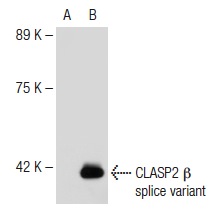
Western blot analysis of CLASP2 expression in non-transfected: (A) and human CLASP2 transfected: (B) 293T whole cell lysates.| Product Name | CLASP2 Antibody (H-40) |
|---|---|
| Antibody Type | Primary Antibodies |
| Antigen Alias | epitope corresponding to amino acids 21-60 mapping near the N-terminus of CLASP2 of human origin |
| Modification Notes | CLASP2 (cytoplasmic linker associated protein 2), also known as KIAA0627 or hOrbit2, is a 1,294 amino acid protein that contains five HEAT repeats and localizes to the cytoplasm and the cytoskeleton, as well as to the kinetochore and the golgi apparatus. Expressed primarily in brain tissue, CLASP2 functions as a microtubule plus-end tracking protein that regulates the stability of dynamic microtubules and is required for the proper polarization of cytoplasmic microtubule arrays in migrating cells. CLASP2 interacts with EB1, EB3, ELKS and CLIP-115 and, in addition to stabilizing microtubules, plays an important role in maintaining the stability of the kinetochore and is crucial for proper chromosomal alignment. CLASP2 is subject to phosphorylation by GSK-3∫, an event that is thought to negatively regulate the ability of CLASP2 to bind to microtubules. Two isoforms of CLASP2, designated beta and gamma, exist due to alternative splicing events. |
| Clonality | Polyclonal |
|---|---|
| Isotype | IgG |
| Host Species | Rabbit |
| Tested Applications | WBIPIFELISA |
| recommended for detection of CLASP2 of mouse, rat and human origin by WB, IP, IF and ELISA also reactive with additional species, including equine, canine, bovine, porcine and avian: |
|
| Species Reactivity | HumanMouseRat |
| Concentration | 1mg/ml |
| Purification | Affinity purified |
| Alternative Names | epitope corresponding to amino acids 21-60 mapping near the N-terminus of CLASP2 of human origin |
|---|---|
| Tissue Specificity | epitope corresponding to amino acids 21-60 mapping near the N-terminus of CLASP2 of human origin |
| Entrez Gene | 23122 |
|---|
Application
Western blot analysis of CLASP2 expression in non-transfected: (A) and human CLASP2 transfected: (B) 293T whole cell lysates.| Application Notes | recommended for detection of CLASP2 of mouse, rat and human origin by WB, IP, IF and ELISA also reactive with additional species, including equine, canine, bovine, porcine and avian: |
|---|
| Form | Liquid |
|---|---|
| Storage Instructions | For short-term storage, store at 4° C. For long-term storage, aliquot and store at -20ºC or below. Avoid multiple freeze-thaw cycles. |
| Storage Buffer | phosphate buffered saline , pH 7.4, 150mM NaCl, 0.02% sodium azide and 50% glycerol. |


