Application
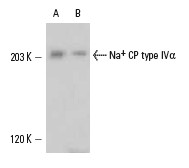
Western blot analysis of Na+ CP type IVα expression in Sol8 whole cell lysate (A) and rat skeletal muscle tissue extract (B).| Product Name | Na+ CP type IVα Antibody (H-90) |
|---|---|
| Antibody Type | Primary Antibodies |
| Antigen Alias | epitope corresponding to amino acids 829-918 mapping within an internal region of Na+ CP type IVα of human origin |
| Modification Notes | Voltage-gated sodium channels are selective ion channels that regulate the permeability of sodium ions in excitable cells. During the propagation of an action potential, sodium channels allow an influx of sodium ions, which rapidly depolarize the cell. The three glycoproteins that comprise the voltage-gated sodium channel proteins include a pore-forming å subunit, a noncovalently associated ∫1 subunit and a disulfide-linked ∫2 subunit. The two ∫ subunits regulate the level of channel expression, modulate gating and function as cell adhesion molecules for cellular aggregation and cytoskeleton interaction. The å subunits of sodium channels type I and III are predominantly expressed in neuronal cell bodies and proximal processes, while type IIå subunits are more abundant along axons. The ∫1 subunit of sodium channel type I is expressed in brain, skeletal and cardiac muscle. In the brain, ∫1 and ∫2 are highly expressed in Purkinje cells, and ∫1 is also expressed in the pyramidal cells of the deep cerebellar nuclei. Impaired voltage-gated sodium channels lead to a number of diseases including myotonia. |
| Clonality | Polyclonal |
|---|---|
| Isotype | IgG |
| Host Species | Rabbit |
| Tested Applications | WBIPIFELISA |
| recommended for detection of Na+ CP type IVα of mouse, rat and human origin by WB, IP, IF and ELISA: |
|
| Species Reactivity | HumanMouseRat |
| Concentration | 1mg/ml |
| Purification | Affinity purified |
| Alternative Names | epitope corresponding to amino acids 829-918 mapping within an internal region of Na+ CP type IV&alpha of human origin |
|---|---|
| Tissue Specificity | epitope corresponding to amino acids 829-918 mapping within an internal region of Na+ CP type IVα of human origin |
| Entrez Gene | 6329 |
|---|
Application
Western blot analysis of Na+ CP type IVα expression in Sol8 whole cell lysate (A) and rat skeletal muscle tissue extract (B).| Application Notes | recommended for detection of Na+ CP type IVα of mouse, rat and human origin by WB, IP, IF and ELISA: |
|---|
| Form | Liquid |
|---|---|
| Storage Instructions | For short-term storage, store at 4° C. For long-term storage, aliquot and store at -20ºC or below. Avoid multiple freeze-thaw cycles. |
| Storage Buffer | phosphate buffered saline , pH 7.4, 150mM NaCl, 0.02% sodium azide and 50% glycerol. |


