Application
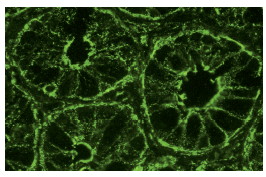
Immunofluorescence staining of normal mouse intestine frozen section showing cytoplasmic staining.Application
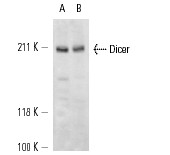
Western blot analysis of Dicer expression in Hep G2 nuclear extract (A) and DT40 whole cell lysate (B).| Product Name | Dicer Antibody (H-212) |
|---|---|
| Antibody Type | Primary Antibodies |
| Antigen Alias | epitope corresponding to amino acids 1701-1912 mapping at the C-terminus of Dicer of human origin |
| Modification Notes | The mammalian Dicer is a type III RNase-related protein with orthologs in yeast, Drosophila and Arabidopsis. Dicer contains an RNA-helicase motif including a DEXH-box in its amino-terminus and an RNase motif in the carboxy-terminus. The gene encoding human Dicer maps to chromosome 14q31. Dicer is expressed in brain, heart, liver, lung, pancreas, kidney and placenta and functions in the RNA interference pathway. Dicer cleaves short hairpin RNA precursors of approximately 70 bp into 21-23 bp dsRNAs that selectively target the destruction of homologous RNAs. Dicer localizes to the cytoplasm of mammalian cells. Specifically, it co-localizes with calreticulin in the endoplasmic reticulum. Although the cleavage of RNA by Dicer is ATP-independent, the product release necessary for the rapid turnover of this enzyme may be attributed to ATP. Immunoprecipitation studies indicate Dicer forms a complex with PIWI domain of eIF2C translation initiation factors. |
| Clonality | Polyclonal |
|---|---|
| Isotype | IgG |
| Host Species | Rabbit |
| Tested Applications | WBIPIFELISA |
| recommended for detection of Dicer of mouse, rat and human origin by WB, IP, IF and ELISA also reactive with additional species, including equine, canine, bovine, porcine and avian: |
|
| Species Reactivity | HumanMouseRat |
| Concentration | 1mg/ml |
| Purification | Affinity purified |
| Alternative Names | epitope corresponding to amino acids 1701-1912 mapping at the C-terminus of Dicer of human origin |
|---|---|
| Tissue Specificity | epitope corresponding to amino acids 1701-1912 mapping at the C-terminus of Dicer of human origin |
| Entrez Gene | 23405 |
|---|
Application
Immunofluorescence staining of normal mouse intestine frozen section showing cytoplasmic staining.
Application
Western blot analysis of Dicer expression in Hep G2 nuclear extract (A) and DT40 whole cell lysate (B).| Application Notes | recommended for detection of Dicer of mouse, rat and human origin by WB, IP, IF and ELISA also reactive with additional species, including equine, canine, bovine, porcine and avian: |
|---|
| Form | Liquid |
|---|---|
| Storage Instructions | For short-term storage, store at 4° C. For long-term storage, aliquot and store at -20ºC or below. Avoid multiple freeze-thaw cycles. |
| Storage Buffer | phosphate buffered saline , pH 7.4, 150mM NaCl, 0.02% sodium azide and 50% glycerol. |


