Application
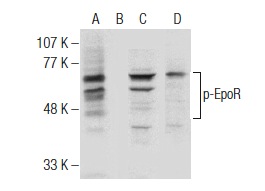
Antibodies tested include p-EpoR (Tyr 456)-R: (A,B) and EpoR (C-20): (C,D).Application
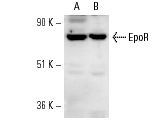
Western blot analysis of EpoR expression in K-562 (A) and Jurkat (B) whole cell lysates.| Product Name | EpoR Antibody (C-20) |
|---|---|
| Antibody Type | Primary Antibodies |
| Antigen Alias | epitope mapping within a C-terminal cytoplasmic domain of EpoR of human origin |
| Modification Notes | Erythropoiesis is regulated through the interaction of erythropoietin (Epo) with its receptor, EpoR, a member of the cytokine superfamily of receptors. The human EpoR is a 507 amino acid transmembrane protein that forms homodimers following erythropoietin activation and is related to the interleukin 2 (IL-2) receptor b-chain subunit (IL-2Rb). EpoR and IL-2Rb share 45% amino acid identity within the box 1 and box 2 domains of their cytoplasmic regions while their remaining cytoplasmic sequences are highly divergent. These conserved domains are both required and sufficient for mitogenesis and for coupling ligand binding to the induction of tyrosine phosphorylation. The membrane proximal region is also required for the association of JAK2 with EpoR. The existence of multiple cross-linked complexes and differential ligand affinities suggests that EpoR may exist as a multireceptor complex. |
| Clonality | Polyclonal |
|---|---|
| Isotype | IgG |
| Host Species | Rabbit |
| Tested Applications | WBIPIFIHCELISA |
| recommended for detection of erythropoietin (Epo) receptor of human origin by WB, IP, IF, IHC(P) and ELISA also reactive with additional species, including canine and bovine: |
|
| Species Reactivity | HumanMouseRat |
| Concentration | 1mg/ml |
| Purification | Affinity purified |
| Alternative Names | epitope mapping within a C-terminal cytoplasmic domain of EpoR of human origin |
|---|---|
| Tissue Specificity | epitope mapping within a C-terminal cytoplasmic domain of EpoR of human origin |
| Entrez Gene | 2057 |
|---|
Application
Antibodies tested include p-EpoR (Tyr 456)-R: (A,B) and EpoR (C-20): (C,D).
Application
Western blot analysis of EpoR expression in K-562 (A) and Jurkat (B) whole cell lysates.| Application Notes | recommended for detection of erythropoietin (Epo) receptor of human origin by WB, IP, IF, IHC(P) and ELISA also reactive with additional species, including canine and bovine: |
|---|
| Form | Liquid |
|---|---|
| Storage Instructions | For short-term storage, store at 4° C. For long-term storage, aliquot and store at -20ºC or below. Avoid multiple freeze-thaw cycles. |
| Storage Buffer | phosphate buffered saline , pH 7.4, 150mM NaCl, 0.02% sodium azide and 50% glycerol. |


