Application
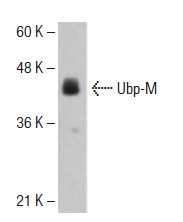
Western blot analysis of Ubp-M expression in Hep G2 whole cell lysate.| Product Name | Ubp-M Antibody (L-25) |
|---|---|
| Antibody Type | Primary Antibodies |
| Antigen Alias | recommended for detection of Ubp-M of human origin by WB, IP and ELISA |
| Modification Notes | Ubiquitin-processing protease-M (Ubp-M) belongs to a family of enzymes that regulate the degradation of ubiquitinated proteins by deubiquitination. Ubiquitin-mediated proteolysis requires the transfer of ubiquitin chains to lysine groups on selected cellular proteins, which then potentiates the pro-teolytic degradation of these conjugated substrates by the 26S proteasome. Ubps, which are also designated deubiquitinating enzymes (DUBs), regulate growth activity and differentiation. Ubp-M is localized to the cytosol and is phosphorylated during the G2/M phase transition through the completion of mitosis. This phosphorylation state coincides with an accumulation of free ubiquitin chains within the cell and an increased hydrolysis of ubiquitin conjugated proteins. Targets of Ubp-M include the histone proteins H2A and H2B, which are monoubiquitinated during interphase and anaphase and are deubuiquitinated during mitoisis. This deubiquitination of the histone proteins correlates to the condensation of the mitotic chromatin, indicating that Ubp-M influences histone function and, thereby, facilitates the organization of mitotic chromatin and directs the progression of cell growth. |
| Clonality | Polyclonal |
|---|---|
| Isotype | IgG |
| Host Species | Rabbit |
| Tested Applications | WBIPELISA |
| WB:1:500~1:2000 IP:1:100~1:500 Notes:Optimal dilutions/concentrations should be determined by the researcher. |
|
| Species Reactivity | HumanMouseRat |
| Concentration | 1mg/ml |
| Purification | Affinity purified |
| Alternative Names | recommended for detection of Ubp-M of human origin by WB IP and ELISA |
|---|---|
| Tissue Specificity | recommended for detection of Ubp-M of human origin by WB, IP and ELISA |
| Entrez Gene | 10600 |
|---|
Application
Western blot analysis of Ubp-M expression in Hep G2 whole cell lysate.| Application Notes | WB:1:500~1:2000 IP:1:100~1:500 Notes:Optimal dilutions/concentrations should be determined by the researcher. |
|---|
| Form | Liquid |
|---|---|
| Storage Instructions | For short-term storage, store at 4° C. For long-term storage, aliquot and store at -20ºC or below. Avoid multiple freeze-thaw cycles. |
| Storage Buffer | phosphate buffered saline , pH 7.4, 150mM NaCl, 0.02% sodium azide and 50% glycerol. |


