Application
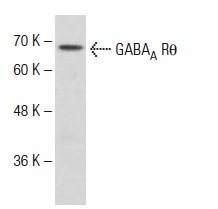
Western blot analysis of GABAA Rθ expression in Jurkat whole cell lysate.| Product Name | GABAA Rθ Antibody (H-25) |
|---|---|
| Antibody Type | Primary Antibodies |
| Antigen Alias | recommended for detection of GABAA Rθ of mouse, rat and human origin by WB, IP and ELISA |
| Modification Notes | Gamma-aminobutyric acid type A (GABAA) receptors mediate inhibitory neurotransmission in the mammalian central nervous system. The receptor exists as a pentameric ion channel composed by heteromeric combinations of alpha, beta, gamma, delta, epsilon, theta, or pi subunits. Only specific subunit combinations produce viable receptors, while others never translocate to the cell surface from the ER where they are synthesized, and subsequently degraded. The theta subunit forms a receptor in combination with alpha3 subunits in monoaminergic cell groups. These receptors, found especially in the septum, preoptic areas, hypothalamic nuclei, amygdala and thalamus, likely have unique pharmacological properties linked to their expression in this particular cell type and not cholinergic cell groups, and may play a role in opiate withdrawl symptoms. |
| Clonality | Polyclonal |
|---|---|
| Isotype | IgG |
| Host Species | Rabbit |
| Tested Applications | WBIPELISA |
| WB:1:500~1:2000 IP:1:100~1:500 Notes:Optimal dilutions/concentrations should be determined by the researcher. |
|
| Species Reactivity | HumanMouseRat |
| Concentration | 1mg/ml |
| Purification | Affinity purified |
| Alternative Names | recommended for detection of GABAA R&theta of mouse rat and human origin by WB IP and ELISA |
|---|---|
| Tissue Specificity | recommended for detection of GABAA Rθ of mouse, rat and human origin by WB, IP and ELISA |
| Entrez Gene | 55879 |
|---|
Application
Western blot analysis of GABAA Rθ expression in Jurkat whole cell lysate.| Application Notes | WB:1:500~1:2000 IP:1:100~1:500 Notes:Optimal dilutions/concentrations should be determined by the researcher. |
|---|
| Form | Liquid |
|---|---|
| Storage Instructions | For short-term storage, store at 4° C. For long-term storage, aliquot and store at -20ºC or below. Avoid multiple freeze-thaw cycles. |
| Storage Buffer | phosphate buffered saline , pH 7.4, 150mM NaCl, 0.02% sodium azide and 50% glycerol. |


