Application
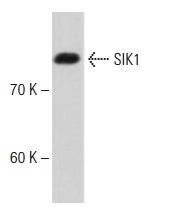
Western blot analysis of SIK1 expression in Jurkat whole cell lysate.Application
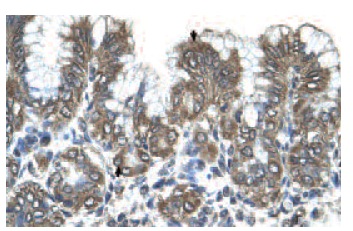
Immunoperoxidase staining of formalin-fixed, paraffin-embedded human stomach tissue showing nuclear and cytoplasmic localization.| Product Name | SIK1 Antibody (E-22) |
|---|---|
| Antibody Type | Primary Antibodies |
| Antigen Alias | recommended for detection of SIK1 of human origin by WB, IP, IF, IHC(P) and ELISA |
| Modification Notes | The phosphorylation and dephosphorylation of proteins on serine and threonine residues is an essential means of regulating a broad range of cellular functions in eukaryotes, including cell division, homeostasis and apoptosis. A group of proteins that are intimately involved in this process are the serine/threonine (Ser/Thr) protein kinases. SIK1 (salt-inducible kinase 1), also known as SNF1LK or MSK, is a 783 amino acid protein that contains one UBA domain and one protein kinase domain and belongs to the Ser/Thr protein kinase family. Localized to both the nucleus and the cytoplasm, SIK1 uses magnesium as a cofactor to catalyze the ATP-dependent phosphorylation of target proteins and is thought to be important for the early stages of skeletal muscle growth and myocardial cell differentiation. Additionally, SIK1 has a potential role in regulation of the G2/M cell cycle transition, as well as in inhibitory control of CREB protein function. |
| Clonality | Polyclonal |
|---|---|
| Isotype | IgG |
| Host Species | Rabbit |
| Tested Applications | WBIPIFIHCELISA |
| WB:1:500~1:2000 IP:1:100~1:500 IF:1:200~1:500 IHC:1:50~1:200 Notes:Optimal dilutions/concentrations should be determined by the researcher. |
|
| Species Reactivity | HumanMouseRat |
| Concentration | 1mg/ml |
| Purification | Affinity purified |
| Alternative Names | recommended for detection of SIK1 of human origin by WB IP IF IHC(P) and ELISA |
|---|---|
| Tissue Specificity | recommended for detection of SIK1 of human origin by WB, IP, IF, IHC(P) and ELISA |
| Entrez Gene | 150094 |
|---|
Application
Western blot analysis of SIK1 expression in Jurkat whole cell lysate.
Application
Immunoperoxidase staining of formalin-fixed, paraffin-embedded human stomach tissue showing nuclear and cytoplasmic localization.| Application Notes | WB:1:500~1:2000 IP:1:100~1:500 IF:1:200~1:500 IHC:1:50~1:200 Notes:Optimal dilutions/concentrations should be determined by the researcher. |
|---|
| Form | Liquid |
|---|---|
| Storage Instructions | For short-term storage, store at 4° C. For long-term storage, aliquot and store at -20ºC or below. Avoid multiple freeze-thaw cycles. |
| Storage Buffer | phosphate buffered saline , pH 7.4, 150mM NaCl, 0.02% sodium azide and 50% glycerol. |


