Application
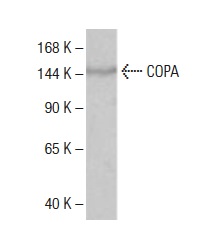
Western blot analysis of COPA expression in HeLa whole cell lysate.| Product Name | COPA Antibody (D-24) |
|---|---|
| Antibody Type | Primary Antibodies |
| Antigen Alias | recommended for detection of COPA of mouse and human origin by WB, IP and ELISA |
| Modification Notes | COPA (å-coat protein) is processed to produce Xenin. Xenin stimulates exocrine pancreatic secretion to affect small and large intestinal motility, and inhibits pentagastrin-stimulated secretion of acid. In the gut, Xenin interacts with the neurotensin receptor. Membrane and vesicular trafficking in the early secretory pathway are mediated by non-Clathrin COP (coat protein) I-coated vesicles. COPI-coated vesicles mediate retrograde transport from the Golgi back to the ER and intra-Golgi transport. The cytosolic precursor of the COPI coat, the heptameric coatomer complex, is composed of two subcomplexes. The first consists of the COPB, COPG, COPD and COPZ subunits (also known as b-, g-, d- and z-COP, respectively), which are distantly homologous to AP Clathrin adaptor subunits. The second consists of the COPA, b'-COP and COPE subunits (also known as a-COP, COPP and e-COP,respectively). |
| Clonality | Polyclonal |
|---|---|
| Isotype | IgG |
| Host Species | Rabbit |
| Tested Applications | WBIPELISA |
| WB:1:500~1:2000 IP:1:100~1:500 Notes:Optimal dilutions/concentrations should be determined by the researcher. |
|
| Species Reactivity | HumanMouseRat |
| Concentration | 1mg/ml |
| Purification | Affinity purified |
| Alternative Names | recommended for detection of COPA of mouse and human origin by WB IP and ELISA |
|---|---|
| Tissue Specificity | recommended for detection of COPA of mouse and human origin by WB, IP and ELISA |
| Entrez Gene | 1314 |
|---|
Application
Western blot analysis of COPA expression in HeLa whole cell lysate.| Application Notes | WB:1:500~1:2000 IP:1:100~1:500 Notes:Optimal dilutions/concentrations should be determined by the researcher. |
|---|
| Form | Liquid |
|---|---|
| Storage Instructions | For short-term storage, store at 4° C. For long-term storage, aliquot and store at -20ºC or below. Avoid multiple freeze-thaw cycles. |
| Storage Buffer | phosphate buffered saline , pH 7.4, 150mM NaCl, 0.02% sodium azide and 50% glycerol. |


