Application
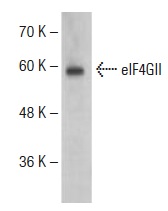
Western blot analysis of eIF4GII expression in Jurkat whole cell lysate.| Product Name | eIF4GII Antibody (V-23) |
|---|---|
| Antibody Type | Primary Antibodies |
| Antigen Alias | recommended for detection of eIF4GII of human origin by WB, IP and ELISA |
| Modification Notes | Translation initiation in eukaryotes necessitates the assembly of an 80S ribosomal complex. Eukaryotic initiation factors (eIFs) are utilized in a sequence of reactions that leads to 80S ribosomal assembly and initiation of translation. Mammalian eukaryotic translation initiation factor 4F (eIF4F) is a protein complex that contains eIF4A, eIF4E and eIF4G, binds mRNA at a 5’-cap motif and recruits the 43S ribosomal preinitiation complex to the transcript. Along with eIF4B, the eIF4F complex mediates the unwinding of mRNA secondary structure to facilitate ribosome association. eIF4E specifically interacts with the 5’ cap, eIF4A is a bidirectional RNA helicase, and eIF4GI and eIF4GII are scaffolding proteins which coordinate eIF4E, eIF4A, eIF3 and the 40S ribosome. eIF4GII (also known as eIF4G3 and eIF4-g3) is a 1,585 amino acid protein that is 46% homologous and functionally similar to eIF4GI. |
| Clonality | Polyclonal |
|---|---|
| Isotype | IgG |
| Host Species | Rabbit |
| Tested Applications | WBIPELISA |
| WB:1:500~1:2000 IP:1:100~1:500 Notes:Optimal dilutions/concentrations should be determined by the researcher. |
|
| Species Reactivity | HumanMouseRat |
| Concentration | 1mg/ml |
| Purification | Affinity purified |
| Alternative Names | recommended for detection of eIF4GII of human origin by WB IP and ELISA |
|---|---|
| Tissue Specificity | recommended for detection of eIF4GII of human origin by WB, IP and ELISA |
| Entrez Gene | 8672 |
|---|
Application
Western blot analysis of eIF4GII expression in Jurkat whole cell lysate.| Application Notes | WB:1:500~1:2000 IP:1:100~1:500 Notes:Optimal dilutions/concentrations should be determined by the researcher. |
|---|
| Form | Liquid |
|---|---|
| Storage Instructions | For short-term storage, store at 4° C. For long-term storage, aliquot and store at -20ºC or below. Avoid multiple freeze-thaw cycles. |
| Storage Buffer | phosphate buffered saline , pH 7.4, 150mM NaCl, 0.02% sodium azide and 50% glycerol. |


