Application
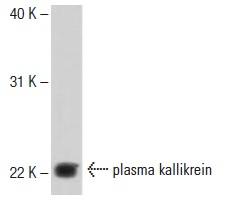
Western blot analysis of plasma kallikrein expression in human fetal liver tissue extract.| Product Name | plasma kallikrein Antibody (H-25) |
|---|---|
| Antibody Type | Primary Antibodies |
| Antigen Alias | recommended for detection of plasma kallikrein of human origin by WB, IP and ELISA |
| Modification Notes | Plasma prekallikrein is a glycoprotein that is synthesized in the liver and is secreted into the blood as a single polypeptide chain that participates in the surface-dependent activation of blood coagulation, fibrinolysis, kinin generation and inflammation. The human plasma prekallikrein gene maps to chromosome 4q34-q35 and encodes a serine proteinase known as Fletcher factor. Plasma prekallikrein converts to plasma kallikrein by Factor XII A through the cleavage of an internal Arg-Ile bond. Plasma kallikrein releases bradykinin when activated by Gram-negative septicemia or irreversible hemorrhagic shock. Plasma prekallikrein activation induces the cleavage of high molecular weight kininogen (HK) and subsequent liberation of bradykinin. Cleaved HK is antiangiogenic, and bradykinin stimulates tPA liberation and nitric oxide formation. Activated plasma kallikrein promotes single-chain urokinase activation and subsequent plasminogen activation. Kininigens and their breakdown products are antithrombin agents . |
| Clonality | Polyclonal |
|---|---|
| Isotype | IgG |
| Host Species | Rabbit |
| Tested Applications | WBIPELISA |
| WB:1:500~1:2000 IP:1:100~1:500 Notes:Optimal dilutions/concentrations should be determined by the researcher. |
|
| Species Reactivity | HumanMouseRat |
| Concentration | 1mg/ml |
| Purification | Affinity purified |
| Alternative Names | recommended for detection of plasma kallikrein of human origin by WB IP and ELISA |
|---|---|
| Tissue Specificity | recommended for detection of plasma kallikrein of human origin by WB, IP and ELISA |
| Entrez Gene | 3818 |
|---|
Application
Western blot analysis of plasma kallikrein expression in human fetal liver tissue extract.| Application Notes | WB:1:500~1:2000 IP:1:100~1:500 Notes:Optimal dilutions/concentrations should be determined by the researcher. |
|---|
| Form | Liquid |
|---|---|
| Storage Instructions | For short-term storage, store at 4° C. For long-term storage, aliquot and store at -20ºC or below. Avoid multiple freeze-thaw cycles. |
| Storage Buffer | phosphate buffered saline , pH 7.4, 150mM NaCl, 0.02% sodium azide and 50% glycerol. |


