Application
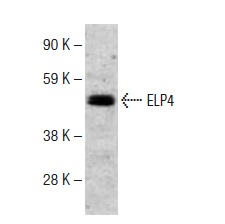
Western blot analysis of ELP4 expression in NIH/3T3 whole cell lysate.| Product Name | ELP4 Antibody (W-21) |
|---|---|
| Antibody Type | Primary Antibodies |
| Antigen Alias | recommended for detection of ELP4 of mouse origin by WB, IP and ELISA |
| Modification Notes | In Saccharomyces cerevisiae, the hyperphosphorylated form of RNA polymerase II (RNAP II) mediates transcription elongation, and associates with the elongator complex, which contains six subunits. The elongator complex can be separated into two subcomplexes; one consisting of Elp1, Elp2 and Elp3, and the other consisting of Elp4, Elp5 and Elp6. The elongator complex acetylates both core histones and nucleosomal substrates, and directs its activity specifically towards the N-terminal tails of Histone H3 and Histone H4. An analogous complex exists in mammals and contains a variety of proteins that are functional homologs of their yeast counterparts. ELP4 (elongation protein 4), also known as PAX6NEB, is a 424 amino acid protein that localizes to both the cytoplasm and the nucleus and exists as a component of the elongator complex. Widely expressed as multiple alternatively spliced isoforms, ELP4 is involved in transcriptional regulation and may play a role in chromatin remodeling. |
| Clonality | Polyclonal |
|---|---|
| Isotype | IgG |
| Host Species | Rabbit |
| Tested Applications | WBIPELISA |
| WB:1:500~1:2000 IP:1:100~1:500 Notes:Optimal dilutions/concentrations should be determined by the researcher. |
|
| Species Reactivity | HumanMouseRat |
| Concentration | 1mg/ml |
| Purification | Affinity purified |
| Alternative Names | recommended for detection of ELP4 of mouse origin by WB IP and ELISA |
|---|---|
| Tissue Specificity | recommended for detection of ELP4 of mouse origin by WB, IP and ELISA |
| Entrez Gene | 77766 |
|---|
Application
Western blot analysis of ELP4 expression in NIH/3T3 whole cell lysate.| Application Notes | WB:1:500~1:2000 IP:1:100~1:500 Notes:Optimal dilutions/concentrations should be determined by the researcher. |
|---|
| Form | Liquid |
|---|---|
| Storage Instructions | For short-term storage, store at 4° C. For long-term storage, aliquot and store at -20ºC or below. Avoid multiple freeze-thaw cycles. |
| Storage Buffer | phosphate buffered saline , pH 7.4, 150mM NaCl, 0.02% sodium azide and 50% glycerol. |


