Application
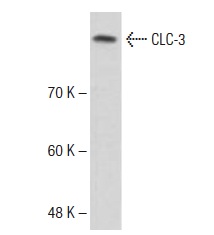
Western blot analysis of CLC-3 expression in Jurkat whole cell lysate.Application
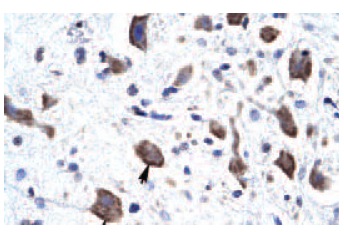
Immunoperoxidase staining of formalin-fixed, paraffin-embedded human brain tissue showing cytoplasmic localization.| Product Name | CLC-3 Antibody (B-21) |
|---|---|
| Antibody Type | Primary Antibodies |
| Antigen Alias | recommended for detection of CLC-3 of human origin by WB, IP, IF, IHC(P) and ELISA |
| Modification Notes | The family of voltage-dependent chloride channels (CLCs) regulate cellular trafficking of chloride ions, a critical component of all living cells. CLCs regulate excitability in muscle and nerve cells, aid in organic solute transport and maintain cellular volume. The genes encoding human CLC-1 through CLC-7 map to chromosomes 7q34, 3q27.1, 4q33, Xp22.2, Xp11.22, 1p36.22 and 16p13.3, respectively. CLC1 is highly expressed in skeletal muscle. Mutations in the gene encoding CLC-1 lead to myotonia, an inheritable disorder characterized by muscle stiffness and renal salt wasting. CLC-2 is highly expressed in the epithelia of several organs including the lungs, which suggests CLC-2 may be a possible therapeutic target for cystic fibrosis. CLC-3 expression is particularly abundant in neuronal tissue, while CLC-4 expression is evident in skeletal and cardiac muscle as well as brain. Mutations in the gene encoding CLC-5 lead to Dent’s disease, a renal disorder characterized by proteinuria and hypercalciuria. CLC-6 and CLC-7 are broadly expressed in several tissues including testis, kidney, brain and muscle. |
| Clonality | Polyclonal |
|---|---|
| Isotype | IgG |
| Host Species | Rabbit |
| Tested Applications | WBIPIFIHCELISA |
| WB:1:500~1:2000 IP:1:100~1:500 IF:1:200~1:500 IHC:1:50~1:200 Notes:Optimal dilutions/concentrations should be determined by the researcher. |
|
| Species Reactivity | HumanMouseRat |
| Concentration | 1mg/ml |
| Purification | Affinity purified |
| Alternative Names | recommended for detection of CLC-3 of human origin by WB IP IF IHC(P) and ELISA |
|---|---|
| Tissue Specificity | recommended for detection of CLC-3 of human origin by WB, IP, IF, IHC(P) and ELISA |
| Entrez Gene | 1182 |
|---|
Application
Western blot analysis of CLC-3 expression in Jurkat whole cell lysate.
Application
Immunoperoxidase staining of formalin-fixed, paraffin-embedded human brain tissue showing cytoplasmic localization.| Application Notes | WB:1:500~1:2000 IP:1:100~1:500 IF:1:200~1:500 IHC:1:50~1:200 Notes:Optimal dilutions/concentrations should be determined by the researcher. |
|---|
| Form | Liquid |
|---|---|
| Storage Instructions | For short-term storage, store at 4° C. For long-term storage, aliquot and store at -20ºC or below. Avoid multiple freeze-thaw cycles. |
| Storage Buffer | phosphate buffered saline , pH 7.4, 150mM NaCl, 0.02% sodium azide and 50% glycerol. |


