Application
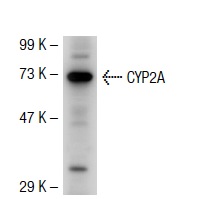
Western blot analysis of CYP2A expression in mouse liver tissue extract.Application
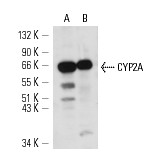
Western blot analysis of CYP2A expression in human liver (A) and mouse liver (B) tissue extracts.| Product Name | CYP2A Antibody (H-110) |
|---|---|
| Antibody Type | Primary Antibodies |
| Antigen Alias | epitope corresponding to amino acids 151-260 mapping within an internal region of CYP2A13 of human origin |
| Modification Notes | P450 enzymes constitute a family of monooxygenase enzymes that are involved in the metabolism of a wide array of endogenous and xenobiotic compounds (1). Several P450 enzymes have been classified by sequence similarities as members of the CYP1A and CYP2A subfamilies (2). NADPH cytochrome P450 reductase is a microsomal enzyme responsible for the transfer of electrons from NADPH to cytochrome P450 enzymes during the P450 catalytic cycle (3,4). NADPH cytochrome P450 reductase is localized to the endoplasmic reticulum where it is also able to transfer electrons to heme oxygenase and cytochrome b5 (5,6). NADPH cytochrome P450 reductase is structurally related to two separate flavoprotein families, ferredoxin nucleotide reductase (FNR) and flavodoxin (7). Electron transfer of NADPH cytochrome P450 reductase requires the binding of two flavin cofactors, FAD and FMN, to the FNR and flavodoxin domains, respectively (8). |
| Clonality | Polyclonal |
|---|---|
| Isotype | IgG |
| Host Species | Rabbit |
| Tested Applications | WBIPIFELISA |
| recommended for detection of a broad range of cytochrome P4502A family members of mouse, rat and human origin by WB, IP, IF and ELISA also reactive with additional species, including equine, canine, bovine and porcine: |
|
| Species Reactivity | HumanMouseRat |
| Concentration | 1mg/ml |
| Purification | Affinity purified |
| Alternative Names | epitope corresponding to amino acids 151-260 mapping within an internal region of CYP2A13 of human origin |
|---|---|
| Tissue Specificity | epitope corresponding to amino acids 151-260 mapping within an internal region of CYP2A13 of human origin |
| Entrez Gene | 1548 |
|---|
Application
Western blot analysis of CYP2A expression in mouse liver tissue extract.
Application
Western blot analysis of CYP2A expression in human liver (A) and mouse liver (B) tissue extracts.| Application Notes | recommended for detection of a broad range of cytochrome P4502A family members of mouse, rat and human origin by WB, IP, IF and ELISA also reactive with additional species, including equine, canine, bovine and porcine: |
|---|
| Form | Liquid |
|---|---|
| Storage Instructions | For short-term storage, store at 4° C. For long-term storage, aliquot and store at -20ºC or below. Avoid multiple freeze-thaw cycles. |
| Storage Buffer | phosphate buffered saline , pH 7.4, 150mM NaCl, 0.02% sodium azide and 50% glycerol. |


