Application
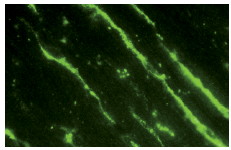
Immunofluorescence staining of normal mouse heart frozen section showing membrane staining.| Product Name | TRPC4/5 Antibody (H-80) |
|---|---|
| Antibody Type | Primary Antibodies |
| Antigen Alias | epitope corresponding to amino acids 1-80 mapping within an N-terminal cytoplasmic domain of TRPC5 of human origin |
| Modification Notes | Transient receptor potential cation (TRPC) channels are a superfamily of six transmembrane segment-spanning, gated cation channels. TRPC subtypes mediate store-operated Ca2+ entry, a process involving Ca2+ influx and replenishment of Ca2+ stores formerly emptied through the action of inositol 1,4,5-trisphosphate production and other Ca2+ mobilizing agents. TRPC channels influence calcium-depletion induced calcium influx processes in response to chemo-, mechano- and osmoregulatory events. Human TRPC4 protein, also known as Trp4, functions as a cation channel and is a constituent of native store-operated Ca2+-permeable channels. In the presence of elevated Ca2+ concentrations, TRPC4 binds Calmodulin (CaM) at an interface which comprises amino acids 688-759 and 786-848 of TRPC4. The ability of TRPC4 to increase inwardly rectifying K+ currents suggests that TRPC4 may contribute to the formation of a novel K+ channel or up-regulate endogenous inwardly rectifying K+ channel expression or activity. The human TRPC5 protein is specifically expressed in brain and forms a nonselective cation channel with TRPC1 in the hippocampus that is activated by Gq-coupled receptors, but not by depletion of intracellular Ca2+ stores. |
| Clonality | Polyclonal |
|---|---|
| Isotype | IgG |
| Host Species | Rabbit |
| Tested Applications | WBIPIFELISA |
| recommended for detection of TRPC4 and TRPC5 of mouse, rat and human origin by WB, IP, IF and ELISA also reactive with additional species, including equine, canine, bovine, porcine and avian: |
|
| Species Reactivity | HumanMouseRat |
| Concentration | 1mg/ml |
| Purification | Affinity purified |
| Alternative Names | epitope corresponding to amino acids 1-80 mapping within an N-terminal cytoplasmic domain of TRPC5 of human origin |
|---|---|
| Tissue Specificity | epitope corresponding to amino acids 1-80 mapping within an N-terminal cytoplasmic domain of TRPC5 of human origin |
| Entrez Gene | 7223 |
|---|
Application
Immunofluorescence staining of normal mouse heart frozen section showing membrane staining.| Application Notes | recommended for detection of TRPC4 and TRPC5 of mouse, rat and human origin by WB, IP, IF and ELISA also reactive with additional species, including equine, canine, bovine, porcine and avian: |
|---|
| Form | Liquid |
|---|---|
| Storage Instructions | For short-term storage, store at 4° C. For long-term storage, aliquot and store at -20ºC or below. Avoid multiple freeze-thaw cycles. |
| Storage Buffer | phosphate buffered saline , pH 7.4, 150mM NaCl, 0.02% sodium azide and 50% glycerol. |


