Application
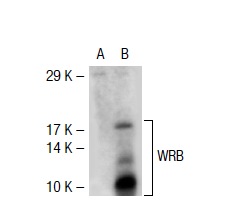
Western blot analysis of WRB expression in non-transfected: (A) and human WRB transfected: (B) 293T whole cell lysates.| Product Name | WRB Antibody (E-20) |
|---|---|
| Antibody Type | Primary Antibodies |
| Antigen Alias | epitope mapping within an internal region of WRB of human origin |
| Modification Notes | WRB, also known as congenital heart disease 5 protein (CHD5), is a 174 amino acid nuclear protein that has a potential nuclear localization signal and a tryptophan-rich C-terminus. Widely expressed in both adult and fetal tissues, WRB is encoded by a gene that localizes to a region on chromosome 21 that is associated with congenital heart disease (CHD) in Down syndrome (DS) patients. DS, a chromosomal disorder caused by an extra copy of chromosome 21, is characterized by poor muscle tone, impaired cognitive ability, retarded physical growth and an increased risk for CHD. Due to its location on chromosome 21, WRB may be involved in the pathogenesis of DS-related heart disease. |
| Clonality | Polyclonal |
|---|---|
| Isotype | IgG |
| Host Species | Rabbit |
| Tested Applications | WBIPIFELISA |
| recommended for detection of WRB of mouse, rat and human origin by WB, IP, IF and ELISA also reactive with additional species, including equine, canine, bovine, porcine and avian: |
|
| Species Reactivity | HumanMouseRat |
| Concentration | 1mg/ml |
| Purification | Affinity purified |
| Alternative Names | epitope mapping within an internal region of WRB of human origin |
|---|---|
| Tissue Specificity | epitope mapping within an internal region of WRB of human origin |
| Entrez Gene | 7485 |
|---|
Application
Western blot analysis of WRB expression in non-transfected: (A) and human WRB transfected: (B) 293T whole cell lysates.| Application Notes | recommended for detection of WRB of mouse, rat and human origin by WB, IP, IF and ELISA also reactive with additional species, including equine, canine, bovine, porcine and avian: |
|---|
| Form | Liquid |
|---|---|
| Storage Instructions | For short-term storage, store at 4° C. For long-term storage, aliquot and store at -20ºC or below. Avoid multiple freeze-thaw cycles. |
| Storage Buffer | phosphate buffered saline , pH 7.4, 150mM NaCl, 0.02% sodium azide and 50% glycerol. |


