Application
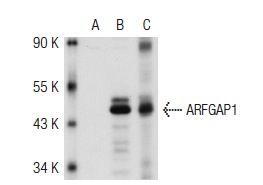
Western blot analysis of ARFGAP1 expression in non-transfected: (A) and human ARFGAP1 transfected: (B) 293 whole cell lysates and mouse brain tissue extract (C).| Product Name | ARFGAP1 Antibody (S-17) |
|---|---|
| Antibody Type | Primary Antibodies |
| Antigen Alias | epitope mapping within an internal region of ARFGAP1 of human origin |
| Modification Notes | ARFGAP1 (ADP-ribosylation factor GTPase activating protein 1), also known as ARF1 GAP, is a 406 amino acid protein that contains one ARF-GAP domain and localizes to the cytoplasm and the golgi apparatus. Functioning as a GTPase-activating protein (GAP), ARFGAP1 interacts with ARF1 and promotes hydrolysis of ARF1-bound GTP, an event that is required for both the dissociation of coat proteins from golgi structures and for the subsequent fusion of golgi vesicles with target compartments. When overexpressed, ARFGAP1, whose activity is inhibited by phosphatidylcholine and stimulated by phosphoinosides, can induce the redistribution of the entire golgi apparatus to the endoplasmic reticulum. Multiple isoforms of ARFGAP1 exist due to alternative splicing events. |
| Clonality | Polyclonal |
|---|---|
| Isotype | IgG |
| Host Species | Rabbit |
| Tested Applications | WBIPIFELISA |
| recommended for detection of ARFGAP1 of mouse, rat and human origin by WB, IF and ELISA also reactive with additional species, including canine, bovine and avian: |
|
| Species Reactivity | HumanMouseRat |
| Concentration | 1mg/ml |
| Purification | Affinity purified |
| Alternative Names | epitope mapping within an internal region of ARFGAP1 of human origin |
|---|---|
| Tissue Specificity | epitope mapping within an internal region of ARFGAP1 of human origin |
| Entrez Gene | 55738 |
|---|
Application
Western blot analysis of ARFGAP1 expression in non-transfected: (A) and human ARFGAP1 transfected: (B) 293 whole cell lysates and mouse brain tissue extract (C).| Application Notes | recommended for detection of ARFGAP1 of mouse, rat and human origin by WB, IF and ELISA also reactive with additional species, including canine, bovine and avian: |
|---|
| Form | Liquid |
|---|---|
| Storage Instructions | For short-term storage, store at 4° C. For long-term storage, aliquot and store at -20ºC or below. Avoid multiple freeze-thaw cycles. |
| Storage Buffer | phosphate buffered saline , pH 7.4, 150mM NaCl, 0.02% sodium azide and 50% glycerol. |


