Application
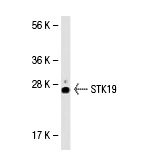
Western blot analysis of STK19 expression in HL60 whole cell lysate.| Product Name | STK19 Antibody (C-18) |
|---|---|
| Antibody Type | Primary Antibodies |
| Antigen Alias | recommended for detection of STK19 of human origin by WB, IP and ELISA |
| Modification Notes | The phosphorylation of proteins by protein kinases and protein phosphatases is a key event in most nuclear and cytoplasmic processes. The ability to activate and deactivate proteins via phosphorylation or dephosphorylation is important for cell division, cell differentiation, DNA repair and transcription. STK19 (serine/threonine kinase 19), also known as G11, RP1, D6S60, D6S60E or HLA-RP1, is a 368 amino acid protein that localizes to the nucleus and is a member of the superfamily of serine/threonine protein kinases. Expressed in monocytes, hepatocytes, epithelial cells and T- and B-lymphocytes, STK19 is a protein kinase that can catalytically phosphorylate serine and threonine residues on proteins such as histones and caseins. STK19 functions in an ATP-dependent manner and uses divalent cations, including manganese, as cofactors. Multiple isoforms of STK19 exist due to alternative splicing events. |
| Clonality | Polyclonal |
|---|---|
| Isotype | IgG |
| Host Species | Rabbit |
| Tested Applications | WBIPELISA |
| WB:1:500~1:2000 IP:1:100~1:500 Notes:Optimal dilutions/concentrations should be determined by the researcher. |
|
| Species Reactivity | HumanMouseRat |
| Concentration | 1mg/ml |
| Purification | Affinity purified |
| Alternative Names | recommended for detection of STK19 of human origin by WB IP and ELISA |
|---|---|
| Tissue Specificity | recommended for detection of STK19 of human origin by WB, IP and ELISA |
| Entrez Gene | 8859 |
|---|
Application
Western blot analysis of STK19 expression in HL60 whole cell lysate.| Application Notes | WB:1:500~1:2000 IP:1:100~1:500 Notes:Optimal dilutions/concentrations should be determined by the researcher. |
|---|
| Form | Liquid |
|---|---|
| Storage Instructions | For short-term storage, store at 4° C. For long-term storage, aliquot and store at -20ºC or below. Avoid multiple freeze-thaw cycles. |
| Storage Buffer | phosphate buffered saline , pH 7.4, 150mM NaCl, 0.02% sodium azide and 50% glycerol. |


