Application
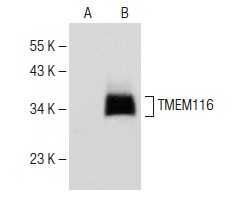
Western blot analysis of TMEM116 expression in non-transfected: (A) and mouse TMEM116 transfected: (B) 293T whole cell lysates.| Product Name | TMEM116 Antibody (A-16) |
|---|---|
| Antibody Type | Primary Antibodies |
| Antigen Alias | epitope mapping near the C-terminus of TMEM116 of human origin |
| Modification Notes | TMEM116 is a 228 amino acid encoded by a gene that maps to human chromosome 12. Encoding over 1,100 genes within 132 million bases, chromosome 12 makes up about 4.5% of the human genome. A number of skeletal deformities are linked to chromosome 12 including hypochondrogenesis, achondrogenesis and Kniest dysplasia. Noonan syndrome, which includes heart and facial developmental defects among the primary symptoms, is caused by a mutant form of PTPN11 gene product, SH-PTP2. Chromosome 12 is also home to a homeobox gene cluster which encodes crucial transcription factors for morphogenesis, and the natural killer complex gene cluster encoding C-type lectin proteins which mediate the NK cell response to MHC I interaction. Trisomy 12p leads to facial development defects, seizure disorders and a host of other symptoms varying in severity depending on the extent of mosaicism and is most severe in cases of complete trisomy. |
| Clonality | Polyclonal |
|---|---|
| Isotype | IgG |
| Host Species | Rabbit |
| Tested Applications | WBIPIFELISA |
| recommended for detection of TMEM116 of mouse, rat and human origin by WB, IP, IF and ELISA non cross-reactive with other TMEM family members also reactive with additional species, including equine: |
|
| Species Reactivity | HumanMouseRat |
| Concentration | 1mg/ml |
| Purification | Affinity purified |
| Alternative Names | epitope mapping near the C-terminus of TMEM116 of human origin |
|---|---|
| Tissue Specificity | epitope mapping near the C-terminus of TMEM116 of human origin |
| Entrez Gene | 89894 |
|---|
Application
Western blot analysis of TMEM116 expression in non-transfected: (A) and mouse TMEM116 transfected: (B) 293T whole cell lysates.| Application Notes | recommended for detection of TMEM116 of mouse, rat and human origin by WB, IP, IF and ELISA non cross-reactive with other TMEM family members also reactive with additional species, including equine: |
|---|
| Form | Liquid |
|---|---|
| Storage Instructions | For short-term storage, store at 4° C. For long-term storage, aliquot and store at -20ºC or below. Avoid multiple freeze-thaw cycles. |
| Storage Buffer | phosphate buffered saline , pH 7.4, 150mM NaCl, 0.02% sodium azide and 50% glycerol. |


