Application
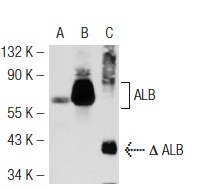
Western blot analysis of ALB expression in Hep G2 (A) and human PBL (B) whole cell lysates and human recombinant ALB (C).Application
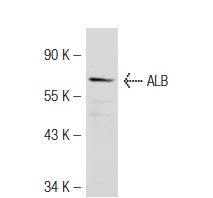
Western blot analysis of ALB expression in Hep G2 whole cell lysate.| Product Name | ALB Antibody (H-126) |
|---|---|
| Antibody Type | Primary Antibodies |
| Antigen Alias | epitope corresponding to amino acids 39-164 mapping near the N-terminus of serum albumin of human origin |
| Modification Notes | Serum albumin (ALB), the main protein in plasma, has a very good binding capacity for water, fatty acids, calcium, sodium, bilirubin, hormones, potassium and drugs. The primary function of ALB is to regulate the colloidal osmotic pressure of blood. Albumin is synthesized in the liver as preproalbumin, which has an N-terminal peptide that is removed before the nascent protein is released from the rough endoplasmic reticulum. The product, proalbumin, is in turn cleaved in the Golgi vesicles to produce the secreted form of albumin. Mutations in the ALB gene may result in familial dysalbuminemic hyperthyroxinemia (FDH), a form of euthyroid hyperthyroxinemia that is due to increased affinity of ALB for T4. FDH is the most common cause of inherited euthyroid hyperthyroxinemia in Caucasian populations. |
| Clonality | Polyclonal |
|---|---|
| Isotype | IgG |
| Host Species | Rabbit |
| Tested Applications | WBIPIFELISA |
| recommended for detection of serum albumin of human origin by WB, IP, IF and ELISA: |
|
| Species Reactivity | HumanMouseRat |
| Concentration | 1mg/ml |
| Purification | Affinity purified |
| Alternative Names | epitope corresponding to amino acids 39-164 mapping near the N-terminus of serum albumin of human origin |
|---|---|
| Tissue Specificity | epitope corresponding to amino acids 39-164 mapping near the N-terminus of serum albumin of human origin |
| Entrez Gene | 213 |
|---|
Application
Western blot analysis of ALB expression in Hep G2 (A) and human PBL (B) whole cell lysates and human recombinant ALB (C).
Application
Western blot analysis of ALB expression in Hep G2 whole cell lysate.| Application Notes | recommended for detection of serum albumin of human origin by WB, IP, IF and ELISA: |
|---|
| Form | Liquid |
|---|---|
| Storage Instructions | For short-term storage, store at 4° C. For long-term storage, aliquot and store at -20ºC or below. Avoid multiple freeze-thaw cycles. |
| Storage Buffer | phosphate buffered saline , pH 7.4, 150mM NaCl, 0.02% sodium azide and 50% glycerol. |


