Application
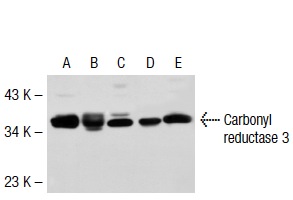
Western blot analysis of Carbonyl reductase 3 expression in HEK293 (A), HEK (B), K-562 (C), Hep G2 (D) and U-698-M (E) whole cell lysates.| Product Name | Carbonyl reductase 3 Antibody (C-16) |
|---|---|
| Antibody Type | Primary Antibodies |
| Antigen Alias | epitope mapping at the C-terminus of Carbonyl reductase 3 of human origin |
| Modification Notes | Carbonyl reductase 1 and Carbonyl reductase 3 belong to the family of short-chain dehydrogenase/reductase proteins that play a role in metabolism throughout the body. Both proteins are monomeric carbonyl reductases that function to catalyze the NADPH-dependent reduction of various carbonyls (generally products of lipid peroxidation) to their corresponding alcohols. Carbonyl reductase 1 and Carbonyl reductase 3 share high sequence similarity at the amino acid level and are responsible for the metabolism of not only endogenous compounds, but of various pharmacological products, as well. Genetic polymorphisms in both proteins result in individual variability at the level of drug metabolism. Defects in the genes encoding Carbonyl reductase proteins have implications in cancer, diabetes and errors in metabolism. |
| Clonality | Polyclonal |
|---|---|
| Isotype | IgG |
| Host Species | Rabbit |
| Tested Applications | WBIPIFELISA |
| recommended for detection of Carbonyl reductase 3 of mouse, rat and human origin by WB, IP, IF and ELISA also reactive with additional species, including equine, canine, bovine and porcine: |
|
| Species Reactivity | HumanMouseRat |
| Concentration | 1mg/ml |
| Purification | Affinity purified |
| Alternative Names | epitope mapping at the C-terminus of Carbonyl reductase 3 of human origin |
|---|---|
| Tissue Specificity | epitope mapping at the C-terminus of Carbonyl reductase 3 of human origin |
| Entrez Gene | 874 |
|---|
Application
Western blot analysis of Carbonyl reductase 3 expression in HEK293 (A), HEK (B), K-562 (C), Hep G2 (D) and U-698-M (E) whole cell lysates.| Application Notes | recommended for detection of Carbonyl reductase 3 of mouse, rat and human origin by WB, IP, IF and ELISA also reactive with additional species, including equine, canine, bovine and porcine: |
|---|
| Form | Liquid |
|---|---|
| Storage Instructions | For short-term storage, store at 4° C. For long-term storage, aliquot and store at -20ºC or below. Avoid multiple freeze-thaw cycles. |
| Storage Buffer | phosphate buffered saline , pH 7.4, 150mM NaCl, 0.02% sodium azide and 50% glycerol. |


