Application
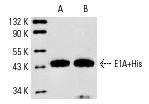
Antibodies tested include Adenovirus-2/5 E1A (M73): (A) and Adenovirus-2/5 E1A (13 S-5): (B).| Product Name | Adenovirus-2/5 E1A Antibody (13 S-5) |
|---|---|
| Antibody Type | Primary Antibodies |
| Antigen Alias | prepared by immunization with full length Adenovirus 13 S E1A fusion protein |
| Modification Notes | The early region (E1) of the adenovirus genome, responsible for transforming activity, is localized within the leftmost 11% of the viral genome (1), and consists of two transcriptional units, E1A and E1B. Region E1A is sufficient for partial transformation and immortalization of primary cells, whereas the E1B function is normally required for complete transformation. In addition to their essential role in transformation, E1A gene products are necessary for normal levels of transcription of the other early regions of the adenovirus genome during productive infection (2,3), and are able to either activate or repress the transcription of specific cellular genes. E1A oncogene proteins form specific complexes with cellular proteins (4). These include the Rb protein, which is the product of the retinoblastoma gene, and the human cyclin A protein (5). E1A immunoprecipitates also contain the cyclin dependent kinase Cdk2 (6). |
| Clonality | Polyclonal |
|---|---|
| Isotype | IgG |
| Host Species | Rabbit |
| Tested Applications | WBIPIFELISA |
| recommended for detection of E1A antigens of Adenovirus-2 and Adenovirus-5 origin by WB, IP, IF and ELISA: |
|
| Species Reactivity | HumanMouseRat |
| Concentration | 1mg/ml |
| Purification | Affinity purified |
| Alternative Names | prepared by immunization with full length Adenovirus 13 S E1A fusion protein |
|---|---|
| Tissue Specificity | prepared by immunization with full length Adenovirus 13 S E1A fusion protein |
Application
Antibodies tested include Adenovirus-2/5 E1A (M73): (A) and Adenovirus-2/5 E1A (13 S-5): (B).| Application Notes | recommended for detection of E1A antigens of Adenovirus-2 and Adenovirus-5 origin by WB, IP, IF and ELISA: |
|---|
| Form | Liquid |
|---|---|
| Storage Instructions | For short-term storage, store at 4° C. For long-term storage, aliquot and store at -20ºC or below. Avoid multiple freeze-thaw cycles. |
| Storage Buffer | phosphate buffered saline , pH 7.4, 150mM NaCl, 0.02% sodium azide and 50% glycerol. |


