Application
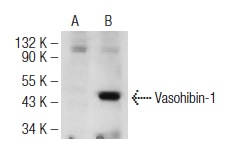
Western blot analysis of Vasohibin-1 expression in non-transfected: (A) and human Vasohibin-1 transfected: (B) 293T whole cell lysates.| Product Name | Vasohibin-1 Antibody (H-54) |
|---|---|
| Antibody Type | Primary Antibodies |
| Antigen Alias | epitope corresponding to amino acids 81-134 mapping within an internal region of Vasohibin-1 of human origin |
| Modification Notes | Angiogenesis is mainly regulated by the balance of several different pro-angiogenic stimulators, such as vascular endothelial growth factor (VEGF) and a diverse group of endogenous inhibitors that are extrinsic to endothelial cells. Vasohibin-1 is a secreted protein that is induced by a specific, self-regulating, feedback inhibition response to inhibit angiogenesis in an anautocrine manner. It inhibits proliferation, migration, and network formation by endothelial cells. This function is specific for endothelial cells as it does not affect migration in other cell types. Vasohibin-1 is primarily expressed in endothelial of the brain and placental tissues with highest abundance in fetal organs. VEGF and fibroblast growth factor 2 up-regulate the expression of Vasohibin-1. In vitro, Vasohibin-1 does not affect cancer cell proliferation, but does inhibit tumor growth and angiogenesis. |
| Clonality | Polyclonal |
|---|---|
| Isotype | IgG |
| Host Species | Rabbit |
| Tested Applications | WBIPIFELISA |
| recommended for detection of Vasohibin-1 of mouse, rat and human origin by WB, IP, IF and ELISA also reactive with additional species, including equine, canine, bovine and porcine: |
|
| Species Reactivity | HumanMouseRat |
| Concentration | 1mg/ml |
| Purification | Affinity purified |
| Alternative Names | epitope corresponding to amino acids 81-134 mapping within an internal region of Vasohibin-1 of human origin |
|---|---|
| Tissue Specificity | epitope corresponding to amino acids 81-134 mapping within an internal region of Vasohibin-1 of human origin |
Application
Western blot analysis of Vasohibin-1 expression in non-transfected: (A) and human Vasohibin-1 transfected: (B) 293T whole cell lysates.| Application Notes | recommended for detection of Vasohibin-1 of mouse, rat and human origin by WB, IP, IF and ELISA also reactive with additional species, including equine, canine, bovine and porcine: |
|---|
| Form | Liquid |
|---|---|
| Storage Instructions | For short-term storage, store at 4° C. For long-term storage, aliquot and store at -20ºC or below. Avoid multiple freeze-thaw cycles. |
| Storage Buffer | phosphate buffered saline , pH 7.4, 150mM NaCl, 0.02% sodium azide and 50% glycerol. |


