Application
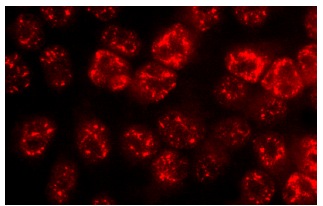
Immunofluorescence staining of methanol-fixed HeLa cells showing nuclear localization.Application
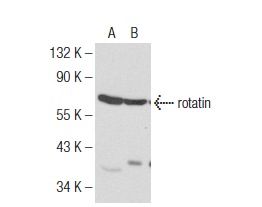
Western blot analysis of rotatin expression in HeLa (A) and Jurkat (B) nuclear extracts.| Product Name | rotatin Antibody (N-14) |
|---|---|
| Antibody Type | Primary Antibodies |
| Antigen Alias | epitope mapping at the N-terminus of rotatin of human origin |
| Modification Notes | The vertebrate body appears externally symmetric, yet the central nervous system and visceral organs are arranged asymmetrically. Recent research suggests that a novel 2,226 amino acid protein called rotatin, which is also known as RTTN, FLJ26356, DKFZp434G145 or FLJ39085, is involved in the early developmental genetic cascade governing left-right specification and axial rotation. Rotatin regulates expression of essential left-right specification genes including Nodal, Lefty and Pitx2 and likely plays a role in notochord development. Studies suggest that rotatin deficiency elicits a recessive lethal mutation called nt (no turning) which causes defects in left-right and axial patterning. Five rotatin isoforms are known to exist as a result of alternative splicing, and the gene encoding rotatin maps to human chromosome 18q22.2. |
| Clonality | Polyclonal |
|---|---|
| Isotype | IgG |
| Host Species | Rabbit |
| Tested Applications | WBIPIFELISA |
| recommended for detection of rotatin of mouse, rat and human origin by WB, IP, IF and ELISA also reactive with additional species, including equine, canine, bovine and porcine: |
|
| Species Reactivity | HumanMouseRat |
| Concentration | 1mg/ml |
| Purification | Affinity purified |
| Alternative Names | epitope mapping at the N-terminus of rotatin of human origin |
|---|---|
| Tissue Specificity | epitope mapping at the N-terminus of rotatin of human origin |
| Entrez Gene | 25914 |
|---|
Application
Immunofluorescence staining of methanol-fixed HeLa cells showing nuclear localization.
Application
Western blot analysis of rotatin expression in HeLa (A) and Jurkat (B) nuclear extracts.| Application Notes | recommended for detection of rotatin of mouse, rat and human origin by WB, IP, IF and ELISA also reactive with additional species, including equine, canine, bovine and porcine: |
|---|
| Form | Liquid |
|---|---|
| Storage Instructions | For short-term storage, store at 4° C. For long-term storage, aliquot and store at -20ºC or below. Avoid multiple freeze-thaw cycles. |
| Storage Buffer | phosphate buffered saline , pH 7.4, 150mM NaCl, 0.02% sodium azide and 50% glycerol. |


