Application
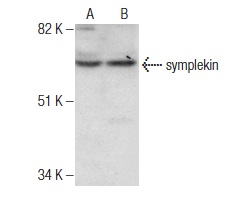
Western blot analysis of symplekin expression in COLO 320DM (A) and MCF7 (B) whole cell lysates.Application
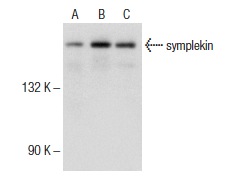
Western blot analysis of symplekin expression in Jurkat (A), K-562 (B) and Caco-2 (C) whole cell lysates.| Product Name | symplekin Antibody (H-300) |
|---|---|
| Antibody Type | Primary Antibodies |
| Antigen Alias | epitope corresponding to amino acids 517-816 mapping within an internal region of symplekin of human origin |
| Modification Notes | Symplekin, also known as SYMPK, SPK or SYM, is a regulatory protein that localizes to the nucleus, cytoplasm, cytoskeleton and cell junction. Expressed in a variety of tissues including testis, pancreas, stomach, liver and fetal brain, symplekin functions to mediate polyadenylation events and promote gene expression. Symplekin is thought to form a high molecular weight complex (called the tight junction complex) with proteins that are involved in polyadenylation and, once in this complex, may serve as a scaffold that recruits regulatory proteins to polyadenylation sites. In addition, symplekin functions independently and plays a role in the 3’-end maturation of histone mRNAs. Defects in the gene encoding symplekin are associated with hepatocellular carcinoma, suggesting a possible role for symplekin in tumor formation. Symplekin is expressed as two isoforms due to alternative splicing events. |
| Clonality | Polyclonal |
|---|---|
| Isotype | IgG |
| Host Species | Rabbit |
| Tested Applications | WBIPIFELISA |
| recommended for detection of symplekin of mouse, rat and human origin by WB, IP, IF and ELISA also reactive with additional species, including canine, bovine and porcine: |
|
| Species Reactivity | HumanMouseRat |
| Concentration | 1mg/ml |
| Purification | Affinity purified |
| Alternative Names | epitope corresponding to amino acids 517-816 mapping within an internal region of symplekin of human origin |
|---|---|
| Tissue Specificity | epitope corresponding to amino acids 517-816 mapping within an internal region of symplekin of human origin |
| Entrez Gene | 8189 |
|---|
Application
Western blot analysis of symplekin expression in COLO 320DM (A) and MCF7 (B) whole cell lysates.
Application
Western blot analysis of symplekin expression in Jurkat (A), K-562 (B) and Caco-2 (C) whole cell lysates.| Application Notes | recommended for detection of symplekin of mouse, rat and human origin by WB, IP, IF and ELISA also reactive with additional species, including canine, bovine and porcine: |
|---|
| Form | Liquid |
|---|---|
| Storage Instructions | For short-term storage, store at 4° C. For long-term storage, aliquot and store at -20ºC or below. Avoid multiple freeze-thaw cycles. |
| Storage Buffer | phosphate buffered saline , pH 7.4, 150mM NaCl, 0.02% sodium azide and 50% glycerol. |


