Application
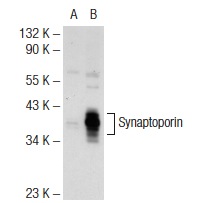
Western blot analysis of Synaptoporin expression in non-transfected: (A) and human Synaptoporin transfected: (B) 293T whole cell lysates.| Product Name | Synaptoporin Antibody (H-60) |
|---|---|
| Antibody Type | Primary Antibodies |
| Antigen Alias | epitope corresponding to amino acids 199-258 mapping near the C-terminus of Synaptoporin of human origin |
| Modification Notes | Synaptic vesicle recycling involves numerous proteins that contribute to the formation and trafficking of the SNARE complexes throughout the cell. Synaptoporin, also designated synaptophysin 2, is an integral membrane protein of small synaptic vesicles that belongs to the synaptophysin/synaptobrevin family. Synaptoporin is highly homologus to Synaptophysin 1 and both Synaptoporin and synaptophysin 1 contain four transmembrane domains and a short cytoplasmic tail. The Synaptoporin protein also contains one MARVEL domain, a membrane-associating domain found in lipid-associating proteins, and displays calcium-binding activity which may be localized to its cytoplasmic tail. Syntaphilin, synaptophysin and Synaptoporin regulate the formation of the vesicles by competing with components of the SNARE complexes to respectively inhibit either the assembly or the secretion of the synaptic vesicles. |
| Clonality | Polyclonal |
|---|---|
| Isotype | IgG |
| Host Species | Rabbit |
| Tested Applications | WBIPIFELISA |
| recommended for detection of Synaptoporin of mouse, rat and human origin by WB, IP, IF and ELISA also reactive with additional species, including equine, canine, bovine and porcine: |
|
| Species Reactivity | HumanMouseRat |
| Concentration | 1mg/ml |
| Purification | Affinity purified |
| Alternative Names | epitope corresponding to amino acids 199-258 mapping near the C-terminus of Synaptoporin of human origin |
|---|---|
| Tissue Specificity | epitope corresponding to amino acids 199-258 mapping near the C-terminus of Synaptoporin of human origin |
| Entrez Gene | 132204 |
|---|
Application
Western blot analysis of Synaptoporin expression in non-transfected: (A) and human Synaptoporin transfected: (B) 293T whole cell lysates.| Application Notes | recommended for detection of Synaptoporin of mouse, rat and human origin by WB, IP, IF and ELISA also reactive with additional species, including equine, canine, bovine and porcine: |
|---|
| Form | Liquid |
|---|---|
| Storage Instructions | For short-term storage, store at 4° C. For long-term storage, aliquot and store at -20ºC or below. Avoid multiple freeze-thaw cycles. |
| Storage Buffer | phosphate buffered saline , pH 7.4, 150mM NaCl, 0.02% sodium azide and 50% glycerol. |


