Application
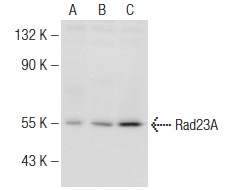
Western blot analysis of Rad23A expression in Jurkat (A), K-562 (B) and HL-60 (C) nuclear extracts.| Product Name | Rad23A Antibody (H-87) |
|---|---|
| Antibody Type | Primary Antibodies |
| Antigen Alias | epitope corresponding to amino acids 81-167 mapping within an internal region of Rad23A of human origin |
| Modification Notes | Mammalian cells express two Rad23 (genome repair protein) homologs, Rad23A (also designated HR23A) and Rad23B (also designated HR23B). In typical cells, mouse Rad23B is approximately ten times more abundant than mouse Rad23A. Endogenous XPC (xeroderma pigmentosum C protein) located in wildtype mouse embryonic fibroblasts is relatively stable; its steady-state level and stability appear to be significantly reduced by a targeted interruption of the mouse Rad23B gene, but not by that of mouse Rad23A. Loss of both mouse Rad23 genes causes a strong further reduction of the XPC protein level. The RAD23 genes (RAD23A and RAD23B), which encode the human Rad23 proteins, are crucial for excision-repair of UV-damaged DNA. RAD23 genes resemble the other DNA repair genes, RAD2, RAD6, RAD7, RAD18 and RAD54, all of which also exhibit increased transcription in response to DNA damage and during meiosis. Rad23 is a nuclear protein containing an ubiquitin-like domain required for biological functions. The protein, which is highly conserved, is involved in nucleotide excision repair (NER) that associates with the proteasome via its N-terminus. The C-terminal ubiquitin-associated domain of Rad23 is evolutionarily conserved from yeast to humans. Rad23 may also act as a regulator for the activity of the 26S Proteasome. |
| Clonality | Polyclonal |
|---|---|
| Isotype | IgG |
| Host Species | Rabbit |
| Tested Applications | WBIPIFELISA |
| recommended for detection of Rad23A of mouse, rat and human origin by WB, IP, IF and ELISA: |
|
| Species Reactivity | HumanMouseRat |
| Concentration | 1mg/ml |
| Purification | Affinity purified |
| Alternative Names | epitope corresponding to amino acids 81-167 mapping within an internal region of Rad23A of human origin |
|---|---|
| Tissue Specificity | epitope corresponding to amino acids 81-167 mapping within an internal region of Rad23A of human origin |
| Entrez Gene | 5886 |
|---|
Application
Western blot analysis of Rad23A expression in Jurkat (A), K-562 (B) and HL-60 (C) nuclear extracts.| Application Notes | recommended for detection of Rad23A of mouse, rat and human origin by WB, IP, IF and ELISA: |
|---|
| Form | Liquid |
|---|---|
| Storage Instructions | For short-term storage, store at 4° C. For long-term storage, aliquot and store at -20ºC or below. Avoid multiple freeze-thaw cycles. |
| Storage Buffer | phosphate buffered saline , pH 7.4, 150mM NaCl, 0.02% sodium azide and 50% glycerol. |


