Application
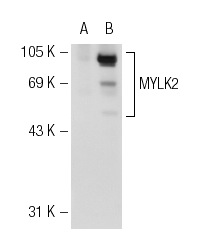
Western blot analysis of MYLK2 expression in non-transfected: (A) and mouse MYLK2 transfected: (B) 293 whole cell lysates.| Product Name | MYLK2 Antibody (R-270) |
|---|---|
| Antibody Type | Primary Antibodies |
| Modification Notes | The Ca2+/calmodulin-dependent protein kinases (CaM kinases) are a structurally related subfamily of serine/threonine kinases that includes CaMKI, CaMKII, CaMKIV and myosin light chain kinases (MYLK, also designated MLCK). The MYLK kinases phosphorylate myosin regulatory light chains to catalyze myosin interaction with actin filaments resulting in contractile activity. Non-muscle, smooth muscle and skeletal/cardiac muscle MYLK isoforms exist. The MYLK gene (also designated MYLK1) encodes both smooth muscle and non-muscle isoforms as well as telokin, a small C-terminal isoform expressed only in smooth muscle with the capacity to stabilize unphosphorylated myosin filaments. Multiple transcript variants are described for the MYLK gene. Smooth-muscle and non-muscle MYLK isoforms are expressed in a wide variety of adult and fetal tissues. The skeletal/cardiac muscle isoforms of MYLK are encoded by a separate gene, MYLK2 (also designated skMLCK). MYLK appears to be a target for PAKs (p21-activated kinases). PAK1 interaction with MYLK results in a decrease in MYLK activity and myosin light chain phosphorylation. |
| Clonality | Polyclonal |
|---|---|
| Isotype | IgG |
| Host Species | Rabbit |
| Tested Applications | WBIPIFELISA |
| recommended for detection of MYLK2 of rat and, to a lesser extent, mouse origin by WB, IP, IF and ELISA | |
| Species Reactivity | HumanMouseRat |
| Concentration | 1mg/ml |
| Purification | Affinity purified |
| Alternative Names | epitope corresponding to amino acids 1-270 mapping at the N-terminus of MYLK2 of rat origin |
|---|---|
| Tissue Specificity | epitope corresponding to amino acids 1-270 mapping at the N-terminus of MYLK2 of rat origin |
| Entrez Gene | 228785 |
|---|
Application
Western blot analysis of MYLK2 expression in non-transfected: (A) and mouse MYLK2 transfected: (B) 293 whole cell lysates.| Application Notes | recommended for detection of MYLK2 of rat and, to a lesser extent, mouse origin by WB, IP, IF and ELISA |
|---|
| Form | Liquid |
|---|---|
| Storage Instructions | For short-term storage, store at 4° C. For long-term storage, aliquot and store at -20ºC or below. Avoid multiple freeze-thaw cycles. |
| Storage Buffer | phosphate buffered saline , pH 7.4, 150mM NaCl, 0.02% sodium azide and 50% glycerol. |


