Application
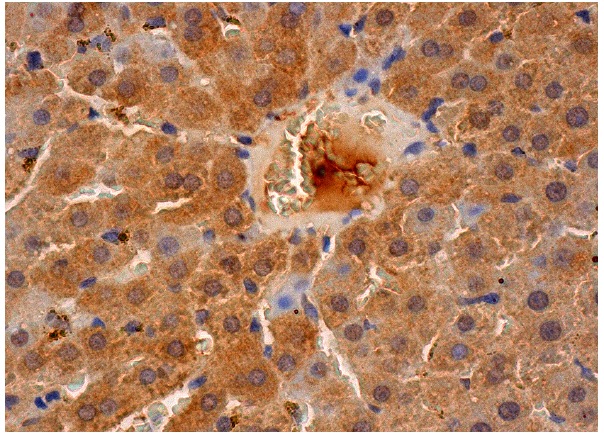
Immunoperoxidase staining of formalin fixed, paraffin-embedded human liver tissue showing cytoplasmic staining of hepatocytes.| Product Name | UGCG Antibody (H-300) |
|---|---|
| Antibody Type | Primary Antibodies |
| Modification Notes | Glucosylceramide synthase (GCS), also designated ceramide glucosyltransferase, belongs to the glycosyltransferase 2 family. It is a widely expressed integral membrane protein encoded by UGCG. The enzyme can be found in the plasma membrane of all eukaryotic cells, and a significant concentration of glucosylceramide synthase activity has been reported in the Golgi complex. Glucosylceramide synthase catalyzes the first glycosylation step in glycosphingolipid biosynthesis and functions as a glucosyltransferase and flippase in the transfer of glucose to ceramide. Glucosylceramide synthase operates in cell recognition, cell proliferation and differentiation, immune recognition and signal transduction. The regulation of ceramide levels through glucosylceramide synthase has been associated with the induction of apoptosis and notable research implicates this relationship with drug-induced apoptosis in a variety of cell types. |
| Clonality | Polyclonal |
|---|---|
| Isotype | IgG |
| Host Species | Rabbit |
| Tested Applications | WBIPIFIHCELISA |
| recommended for detection of UGCG of mouse, rat and human origin by WB, IP, IF, IHC(P) and ELISA also reactive with additional species, including equine, canine, bovine, porcine and avian | |
| Species Reactivity | HumanMouseRat |
| Concentration | 1mg/ml |
| Purification | Affinity purified |
| Alternative Names | epitope corresponding to amino acids 1-300 mapping at the N-terminus of UGCG of human origin |
|---|---|
| Tissue Specificity | epitope corresponding to amino acids 1-300 mapping at the N-terminus of UGCG of human origin |
| Entrez Gene | 7357 |
|---|
Application
Immunoperoxidase staining of formalin fixed, paraffin-embedded human liver tissue showing cytoplasmic staining of hepatocytes.| Application Notes | recommended for detection of UGCG of mouse, rat and human origin by WB, IP, IF, IHC(P) and ELISA also reactive with additional species, including equine, canine, bovine, porcine and avian |
|---|
| Form | Liquid |
|---|---|
| Storage Instructions | For short-term storage, store at 4° C. For long-term storage, aliquot and store at -20ºC or below. Avoid multiple freeze-thaw cycles. |
| Storage Buffer | phosphate buffered saline , pH 7.4, 150mM NaCl, 0.02% sodium azide and 50% glycerol. |


