Application
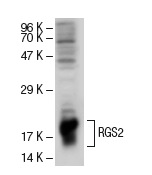
Western blot analysis of RGS2 expression in mouse brain tissue extract.Application
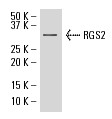
Western blot analysis of RGS2 expression in IMR-32 nuclear extract.Application
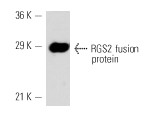
Western blot analysis of human recombinant RGS2 fusion protein.| Product Name | RGS2 Antibody (H-90) |
|---|---|
| Antibody Type | Primary Antibodies |
| Antigen Alias | epitope corresponding to amino acids 1-90 mapping at the N-terminus of RGS2 of human origin |
| Modification Notes | Heterotrimeric G proteins function to relay information from cell surface receptors to intracellular effectors (1). In mammals, G protein a, b and g polypeptides are encoded by at least 16, 4 and 7 genes, respectively (2–6). Most interest in G proteins has been focused on their a subunits, since these proteins bind and hydrolyze GTP and most obviously regulate the activity of the best studied effectors. Several Ga GTP-ase activating proteins (GAPs) have been identified and are designated RGS1, RGS2, RGS4, RGS7, RGS9, RGS10 and GAIP (Gå-interacting protein). Each of these proteins has been shown to deactivate specific Gå isoforms by increasing the rate at which they convert GTP to GDP (7). RGS2 has been shown to be an inhibitor of Gåq function (8). RGS9 expression is restricted to photoreceptor cells and RGS9 has been shown to regulate Gåt (9). |
| Clonality | Polyclonal |
|---|---|
| Isotype | IgG |
| Host Species | Rabbit |
| Tested Applications | WBIPIFELISA |
| recommended for detection of RGS2 of mouse, rat and human origin by WB, IP, IF and ELISA also reactive with additional species, including equine, bovine and porcine: |
|
| Species Reactivity | HumanMouseRat |
| Concentration | 1mg/ml |
| Purification | Affinity purified |
| Alternative Names | epitope corresponding to amino acids 1-90 mapping at the N-terminus of RGS2 of human origin |
|---|---|
| Tissue Specificity | epitope corresponding to amino acids 1-90 mapping at the N-terminus of RGS2 of human origin |
| Entrez Gene | 5997 |
|---|
Application
Western blot analysis of RGS2 expression in mouse brain tissue extract.
Application
Western blot analysis of RGS2 expression in IMR-32 nuclear extract.
Application
Western blot analysis of human recombinant RGS2 fusion protein.| Application Notes | recommended for detection of RGS2 of mouse, rat and human origin by WB, IP, IF and ELISA also reactive with additional species, including equine, bovine and porcine: |
|---|
| Form | Liquid |
|---|---|
| Storage Instructions | For short-term storage, store at 4° C. For long-term storage, aliquot and store at -20ºC or below. Avoid multiple freeze-thaw cycles. |
| Storage Buffer | phosphate buffered saline , pH 7.4, 150mM NaCl, 0.02% sodium azide and 50% glycerol. |


