Application
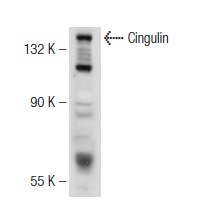
Western blot analysis of Cingulin expression in MDCK whole cell lysate.| Product Name | Cingulin Antibody (H-180) |
|---|---|
| Antibody Type | Primary Antibodies |
| Antigen Alias | epitope corresponding to amino acids 821-1000 mapping near the C-terminus of Cingulin of human origin |
| Modification Notes | Diffusion of solutes is prevented across certain barriers by the formation of tight junction seals. Occludin and Cingulin interact with other proteins to direct the formation and regulation of tight junctions. Cingulin, a protein component of the submembrane plaque of tight junctions (TJ), contains globular and coiled-coil domains and interacts in vitro with several TJ and cytoskeletal proteins, including the PDZ protein ZO-1. Cingulin binding has also been shown to inhibit RhoA activation and signaling with increased Cingulin expression in confluent cells, causing downregulation of RhoA by inhibiting GEF-H1/Lfc. |
| Clonality | Polyclonal |
|---|---|
| Isotype | IgG |
| Host Species | Rabbit |
| Tested Applications | WBIPIFELISA |
| recommended for detection of Cingulin of mouse, rat and human origin by WB, IP, IF and ELISA also reactive with additional species, including equine, canine, bovine and porcine: |
|
| Species Reactivity | HumanMouseRat |
| Concentration | 1mg/ml |
| Purification | Affinity purified |
| Alternative Names | epitope corresponding to amino acids 821-1000 mapping near the C-terminus of Cingulin of human origin |
|---|---|
| Tissue Specificity | epitope corresponding to amino acids 821-1000 mapping near the C-terminus of Cingulin of human origin |
| Entrez Gene | 57530 |
|---|
Application
Western blot analysis of Cingulin expression in MDCK whole cell lysate.| Application Notes | recommended for detection of Cingulin of mouse, rat and human origin by WB, IP, IF and ELISA also reactive with additional species, including equine, canine, bovine and porcine: |
|---|
| Form | Liquid |
|---|---|
| Storage Instructions | For short-term storage, store at 4° C. For long-term storage, aliquot and store at -20ºC or below. Avoid multiple freeze-thaw cycles. |
| Storage Buffer | phosphate buffered saline , pH 7.4, 150mM NaCl, 0.02% sodium azide and 50% glycerol. |


