Application
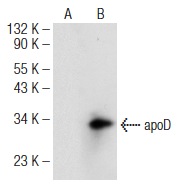
Western blot analysis of apoD expression in non-transfected (A) and human apoD transfected (B) CMV whole cell lysates.| Product Name | apoD Antibody (FL-189) |
|---|---|
| Antibody Type | Primary Antibodies |
| Antigen Alias | epitope corresponding to amino acids 1-189 representing full length apoD of human origin |
| Modification Notes | Lipids, such as phospholipids, triacylglycerols and cholesterol, are weakly soluble in aqueous solution and therefore are transported by circulation as components of lipoproteins. Lipoproteins are globular particles that consist of a non-polar core of triacylglycerols and cholesteryl esters surrounded by phospholipid, cholesterol and an amphiphilic coating of protein, known as apolipoproteins (apo). These complexes allow the dissolution and shuttling of their non-polar lipid components. At least nine different apolipoproteins are distributed in significant amounts in different human lipoproteins. Apolipoprotein D (apoD) is a member of the lipocalin superfamily of transporter proteins that bind small hydrophobic molecules, including arachidonic acid (AA). The ability of apoD to bind AA implicates it in pathways associated with membrane phospholipid signal transduction and metabolism. apoD expression has been shown to correlate both with cell cycle arrest and with prognosis in several types of malignancy, including central nervous system astrocytomas and medulloblastomas. |
| Clonality | Polyclonal |
|---|---|
| Isotype | IgG |
| Host Species | Rabbit |
| Tested Applications | WBIPIFELISA |
| recommended for detection of apoD of human and, to a lesser extent, mouse and rat origin by WB, IP, IF and ELISA: |
|
| Species Reactivity | HumanMouseRat |
| Concentration | 1mg/ml |
| Purification | Affinity purified |
| Alternative Names | epitope corresponding to amino acids 1-189 representing full length apoD of human origin |
|---|---|
| Tissue Specificity | epitope corresponding to amino acids 1-189 representing full length apoD of human origin |
| Entrez Gene | 347 |
|---|
Application
Western blot analysis of apoD expression in non-transfected (A) and human apoD transfected (B) CMV whole cell lysates.| Application Notes | recommended for detection of apoD of human and, to a lesser extent, mouse and rat origin by WB, IP, IF and ELISA: |
|---|
| Form | Liquid |
|---|---|
| Storage Instructions | For short-term storage, store at 4° C. For long-term storage, aliquot and store at -20ºC or below. Avoid multiple freeze-thaw cycles. |
| Storage Buffer | phosphate buffered saline , pH 7.4, 150mM NaCl, 0.02% sodium azide and 50% glycerol. |


