Application
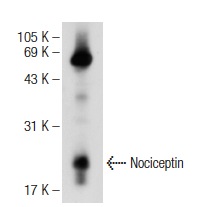
Western blot analysis of Nociceptin expression in mouse brain tissue extract.Application
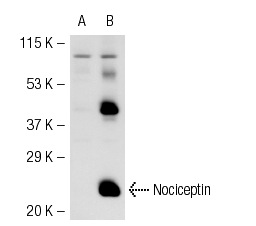
Western blot analysis of Nociceptin expression in non-transfected: (A) and human Nociceptin transfected: (B) 293T whole cell lysates.| Product Name | Nociceptin Antibody (FL-176) |
|---|---|
| Antibody Type | Primary Antibodies |
| Modification Notes | Nociception, a pain response mechanism, occurs in response to stimuli that threaten the integrity of an organism. The first synapses produced as a result of the initiation of nociception are modulated by excitatory amino acids (glutamate and aspartate) and many peptides (substance P, CGRP, CCK, endogenous opioids). Nociceptin (also designated orphanin FQ) is a neuronal peptide that is similar to opioid peptides. Nociceptin activates KOR-3 (kappa-type opioid receptor, also designated ORL1), a G protein-coupled receptor. Although similar to dynorphin A, a kappa opioid peptide, nociceptin functions to make animals hyperreactive to nociceptive stimulations. Nociceptin is also involved in locomotor behavior and may be involved in the modulation of synaptic plasticity in learning and memory. |
| Clonality | Polyclonal |
|---|---|
| Isotype | IgG |
| Host Species | Rabbit |
| Tested Applications | WBIPIFELISA |
| recommended for detection of Nociceptin and Neuropeptide1 and 2 processed active peptides of mouse, rat and human origin by WB, IP, IF and ELISA | |
| Species Reactivity | HumanMouseRat |
| Concentration | 1mg/ml |
| Purification | Affinity purified |
| Alternative Names | epitope corresponding to amino acids 1-176 representing full length Nociceptin of human origin |
|---|---|
| Tissue Specificity | epitope corresponding to amino acids 1-176 representing full length Nociceptin of human origin |
| Entrez Gene | 5368 |
|---|
Application
Western blot analysis of Nociceptin expression in mouse brain tissue extract.
Application
Western blot analysis of Nociceptin expression in non-transfected: (A) and human Nociceptin transfected: (B) 293T whole cell lysates.| Application Notes | recommended for detection of Nociceptin and Neuropeptide1 and 2 processed active peptides of mouse, rat and human origin by WB, IP, IF and ELISA |
|---|
| Form | Liquid |
|---|---|
| Storage Instructions | For short-term storage, store at 4° C. For long-term storage, aliquot and store at -20ºC or below. Avoid multiple freeze-thaw cycles. |
| Storage Buffer | phosphate buffered saline , pH 7.4, 150mM NaCl, 0.02% sodium azide and 50% glycerol. |


