Application
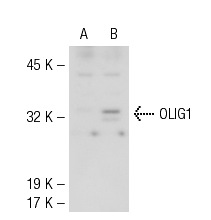
Western blot analysis of OLIG1 expression in non-transfected: (A) and mouse OLIG1 transfected: (B) 293T whole cell lysates.| Product Name | OLIG1 Antibody (M-109) |
|---|---|
| Antibody Type | Primary Antibodies |
| Antigen Alias | epitope corresponding to amino acids 152-260 mapping at the C-terminus of OLIG1 of mouse origin |
| Modification Notes | The oligodendrocyte lineage-specific basic helix-loop-helix (OLIG) family of transcription factors include OLIG1-OLIG3, which differ in tissue expression. OLIG1 and OLIG2 are specifically expressed in nervous tissue as gene regulators of oligodendrogenesis. OLIG2 is more widely expressed in embryonic brain than OLIG1, while OLIG3 is primarily expressed in non-neural tissues. OLIG1 and OLIG2 interact with the Nkx-2.2 homeodomain protein, which is responsible for directing ventral neuronal patterning in response to graded Sonic hedgehog signaling in the embryonic neural tube. These interactions between OLIG proteins and Nkx-2.2 appear to promote the formation of alternate cell types by inhibiting V3 interneuron development. OLIG1 and OLIG2 are abundantly expressed in oligodendroglioma and nearly absent in astrocytomas. Therefore, OLIG proteins are candidates for molecular markers of human glial brain tumors, which are the most common primary malignancies of the human brain. |
| Clonality | Polyclonal |
|---|---|
| Isotype | IgG |
| Host Species | Rabbit |
| Tested Applications | WBIPIFELISA |
| recommended for detection of OLIG1 of mouse, rat and human origin by WB, IP, IF and ELISA also reactive with additional species, including canine, bovine and porcine: |
|
| Species Reactivity | HumanMouseRat |
| Concentration | 1mg/ml |
| Purification | Affinity purified |
| Alternative Names | epitope corresponding to amino acids 152-260 mapping at the C-terminus of OLIG1 of mouse origin |
|---|---|
| Tissue Specificity | epitope corresponding to amino acids 152-260 mapping at the C-terminus of OLIG1 of mouse origin |
| Entrez Gene | 116448 |
|---|
Application
Western blot analysis of OLIG1 expression in non-transfected: (A) and mouse OLIG1 transfected: (B) 293T whole cell lysates.| Application Notes | recommended for detection of OLIG1 of mouse, rat and human origin by WB, IP, IF and ELISA also reactive with additional species, including canine, bovine and porcine: |
|---|
| Form | Liquid |
|---|---|
| Storage Instructions | For short-term storage, store at 4° C. For long-term storage, aliquot and store at -20ºC or below. Avoid multiple freeze-thaw cycles. |
| Storage Buffer | phosphate buffered saline , pH 7.4, 150mM NaCl, 0.02% sodium azide and 50% glycerol. |


