Application
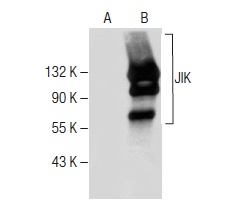
Western blot analysis of JIK expression in non-transfected: (A) and human JIK transfected: (B) 293T whole cell lysates.| Product Name | JIK Antibody (H-60) |
|---|---|
| Antibody Type | Primary Antibodies |
| Antigen Alias | epitope corresponding to amino acids 367-426 mapping within an internal region of JIK of human origin |
| Modification Notes | JNK/SAPK-inhibitory kinase (JIK) is a serine/threonine kinase that belongs to the STE20 kinase family. The kinase domain of JIK is similar to the GCK-like subfamily of STE20 kinases, while its non-catalytic domain is similar to a Caenorhabditis elegans putative serine/threonine kinase, SULU. JIK inhibits c-Jun NH2-terminal kinase/stress-activated protein kinase (JNK/SAPK), which is activated by many types of cellular stresses and extracellular signals. JNK/SAPK regulates cell survival, apoptosis and proliferation in mouse development. JIK is negatively regulated by epidermal growth factor (EGF) and tyrosine kinase receptors. In unstimulated human T cells, JIK is cytoplasmic, whereas in the continuously dividing human T cells of Jurkat lymphoma, JIK is nuclear. |
| Clonality | Polyclonal |
|---|---|
| Isotype | IgG |
| Host Species | Rabbit |
| Tested Applications | WBIPIFELISA |
| suitable control antibody: : sc-JIK (h2): 293T Lysate: |
|
| Species Reactivity | HumanMouseRat |
| Concentration | 1mg/ml |
| Purification | Affinity purified |
| Alternative Names | epitope corresponding to amino acids 367-426 mapping within an internal region of JIK of human origin |
|---|---|
| Tissue Specificity | epitope corresponding to amino acids 367-426 mapping within an internal region of JIK of human origin |
Application
Western blot analysis of JIK expression in non-transfected: (A) and human JIK transfected: (B) 293T whole cell lysates.| Application Notes | suitable control antibody: : sc-JIK (h2): 293T Lysate: |
|---|
| Form | Liquid |
|---|---|
| Storage Instructions | For short-term storage, store at 4° C. For long-term storage, aliquot and store at -20ºC or below. Avoid multiple freeze-thaw cycles. |
| Storage Buffer | phosphate buffered saline , pH 7.4, 150mM NaCl, 0.02% sodium azide and 50% glycerol. |


