Application
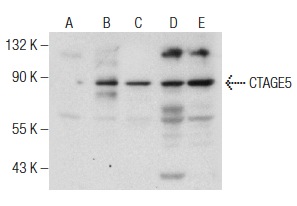
Western blot analysis of CTAGE5 expression in non-transfected 293T: (A), human CTAGE5 transfected 293T: (B), HeLa (C), Jurkat (D) and HuT 78 (E) whole cell lysates.| Product Name | CTAGE2/5 Antibody (H-300) |
|---|---|
| Antibody Type | Primary Antibodies |
| Antigen Alias | epitope corresponding to amino acids 141-440 mapping within an internal region of CTAGE2 of human origin |
| Modification Notes | Cutaneous T cell lymphomas (CTCL) represent a group of malignancies that originate from CD4-T lymphocytes and manifest on the skin. CTCL is a general term for several neoplasms including mycosis fungoides, T cell leukemia/ lymphoma and pagetoid reticulosis, all of which are very difficult to treat in the advanced stages. CTAGE2 (cutaneous T cell lymphoma associated-antigen 2) is a member of the cancer/testis antigen family of proteins (CTAGE) that, under normal conditions, are found primarily in the testis with little or no expression in other parts of the body. Another member of the CTAG family, namely CTAGE5 (also known as MEA11, MEA6, MGEA11 or MGEA6), is a tumor associated antigen that is found in tumors of various origins, including cutaneous T cell lymphomas. Both CTAGE2 and CTAGE5 are expressed as multiple isoforms due to alternative splicing events. |
| Clonality | Polyclonal |
|---|---|
| Isotype | IgG |
| Host Species | Rabbit |
| Tested Applications | WBIPIFELISA |
| recommended for detection of CTAGE2 and CTAGE5 of human origin by WB, IP, IF and ELISA: |
|
| Species Reactivity | HumanMouseRat |
| Concentration | 1mg/ml |
| Purification | Affinity purified |
| Alternative Names | epitope corresponding to amino acids 141-440 mapping within an internal region of CTAGE2 of human origin |
|---|---|
| Tissue Specificity | epitope corresponding to amino acids 141-440 mapping within an internal region of CTAGE2 of human origin |
| Entrez Gene | 4253 |
|---|
Application
Western blot analysis of CTAGE5 expression in non-transfected 293T: (A), human CTAGE5 transfected 293T: (B), HeLa (C), Jurkat (D) and HuT 78 (E) whole cell lysates.| Application Notes | recommended for detection of CTAGE2 and CTAGE5 of human origin by WB, IP, IF and ELISA: |
|---|
| Form | Liquid |
|---|---|
| Storage Instructions | For short-term storage, store at 4° C. For long-term storage, aliquot and store at -20ºC or below. Avoid multiple freeze-thaw cycles. |
| Storage Buffer | phosphate buffered saline , pH 7.4, 150mM NaCl, 0.02% sodium azide and 50% glycerol. |


