Application
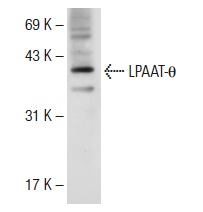
Western blot analysis of LPAAT-θ expression in Caki-1 whole cell lysate.| Product Name | LPAAT-θ Antibody (H-90) |
|---|---|
| Antibody Type | Primary Antibodies |
| Antigen Alias | epitope corresponding to amino acids 1-90 mapping at the N-terminus of LPAAT-θ of human origin |
| Modification Notes | Phosphatidic acid and lysophosphatidic acid are phospholipids involved in lipid biosynthesis and signal transduction. LPAAT-theta (lysophosphatidic acid acyltransferase theta) catalyzes the synthesis of phosphatidic acid from lysophosphatidic acid. LPAAT-theta is a membrane-bound protein belonging to the LPAAT family. Members of the LPAAT family have a well-known role in lipid biosynthesis, and they may also play a role in tumor progression. LPAAT-theta localizes to the endoplasmic reticulum and is expressed in numerous tissue types. Low expression levels are detected in brain, kidney, liver, pancreas, placenta, prostate and thymus. The overexpression of LPAAT-theta can induce FRAP-dependent p70 S6 kinase phosphorylation on Thr389 and 4E-BP1 phosphorylation on Ser65. |
| Clonality | Polyclonal |
|---|---|
| Isotype | IgG |
| Host Species | Rabbit |
| Tested Applications | WBIPIFELISA |
| recommended for detection of LPAAT-θ of mouse, rat and human origin by WB, IP, IF and ELISA also reactive with additional species, including equine, canine, bovine and porcine: |
|
| Species Reactivity | HumanMouseRat |
| Concentration | 1mg/ml |
| Purification | Affinity purified |
| Alternative Names | epitope corresponding to amino acids 1-90 mapping at the N-terminus of LPAAT-&theta of human origin |
|---|---|
| Tissue Specificity | epitope corresponding to amino acids 1-90 mapping at the N-terminus of LPAAT-θ of human origin |
| Entrez Gene | 84803 |
|---|
Application
Western blot analysis of LPAAT-θ expression in Caki-1 whole cell lysate.| Application Notes | recommended for detection of LPAAT-θ of mouse, rat and human origin by WB, IP, IF and ELISA also reactive with additional species, including equine, canine, bovine and porcine: |
|---|
| Form | Liquid |
|---|---|
| Storage Instructions | For short-term storage, store at 4° C. For long-term storage, aliquot and store at -20ºC or below. Avoid multiple freeze-thaw cycles. |
| Storage Buffer | phosphate buffered saline , pH 7.4, 150mM NaCl, 0.02% sodium azide and 50% glycerol. |


