Application
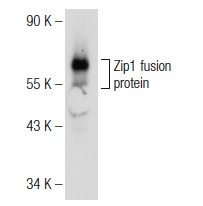
Western blot analysis of yeast recombinant Zip1 fusion protein.| Product Name | Zip1 Antibody (y-300) |
|---|---|
| Antibody Type | Primary Antibodies |
| Antigen Alias | epitope corresponding to amino acids 576-875 mapping at the C-terminus of Zip1 of Saccharomyces cerevisiae origin |
| Modification Notes | Zip1 is a yeast synaptonemal complex (SC) central region component and is required for normal meiotic recombination and crossover interference (1,2). Zip1 plays at least one role in recombination that does not involve SC polymerization along the chromosomes. Perhaps some Zip1 molecules act first in or around the sites of recombinational interactions to influence the recombination process and thence nucleate SC formation (1). Zip1 is predicted to form an alpha-helical coiled coil, flanked by globular domains at the amino and carboxy termini (3,4). The amino-terminal domain of Zip1 is located in the middle of the central region of the SC, whereas the carboxy-terminal domain is embedded in the lateral elements of the complex (4). Furthermore, the carboxy terminus, but not the amino terminus, of Zip1 is required for its localization to chromosomes (3). The zip1 mutant, which exhibits defects in synaptonemal complex formation and meiotic recombination, triggers a checkpoint that causes cells to arrest at the pachytene stage of meiotic prophase (5). |
| Clonality | Polyclonal |
|---|---|
| Isotype | IgG |
| Host Species | Rabbit |
| Tested Applications | WBIPIFELISA |
| recommended for detection of Zip1 of Saccaromyces cerevisiae origin by WB, IP, IF and ELISA: |
|
| Species Reactivity | HumanMouseRat |
| Concentration | 1mg/ml |
| Purification | Affinity purified |
| Alternative Names | epitope corresponding to amino acids 576-875 mapping at the C-terminus of Zip1 of Saccharomyces cerevisiae origin |
|---|---|
| Tissue Specificity | epitope corresponding to amino acids 576-875 mapping at the C-terminus of Zip1 of Saccharomyces cerevisiae origin |
Application
Western blot analysis of yeast recombinant Zip1 fusion protein.| Application Notes | recommended for detection of Zip1 of Saccaromyces cerevisiae origin by WB, IP, IF and ELISA: |
|---|
| Form | Liquid |
|---|---|
| Storage Instructions | For short-term storage, store at 4° C. For long-term storage, aliquot and store at -20ºC or below. Avoid multiple freeze-thaw cycles. |
| Storage Buffer | phosphate buffered saline , pH 7.4, 150mM NaCl, 0.02% sodium azide and 50% glycerol. |


