Application
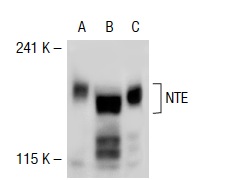
Western blot analysis of NTE expression in non-transfected 293T: (A), human NTE transfected 293T: (B) and HeLa (C) whole cell lysates.| Product Name | NTE Antibody (H-200) |
|---|---|
| Antibody Type | Primary Antibodies |
| Antigen Alias | epitope corresponding to amino acids 291-490 mapping within an internal region of NTE of human origin |
| Modification Notes | Neuropathy target esterase (NTE) is a member of a newly discovered protein family, with a domain conserved through evolution. It is an integral membrane protein present in all neurons and in some non-neural cell types of vertebrates. NTE is important in neural development and has the capacity to hydrolyse esters. It is important in the cell-signalling pathway controlling interactions between neurons and accessory glial cells in nervous system development. NTE can be modified by organophosphates, which can cause neuropathy (characterized by axonal degeneration) in humans. NTE loss can lead to prominent neuronal pathology in the thalamus amd hippocampus and can also lead to defects in the cerebellum. |
| Clonality | Polyclonal |
|---|---|
| Isotype | IgG |
| Host Species | Rabbit |
| Tested Applications | WBIPIFELISA |
| recommended for detection of NTE of mouse, rat and human origin by WB, IP, IF and ELISA also reactive with additional species, including equine, canine, bovine and porcine: |
|
| Species Reactivity | HumanMouseRat |
| Concentration | 1mg/ml |
| Purification | Affinity purified |
| Alternative Names | epitope corresponding to amino acids 291-490 mapping within an internal region of NTE of human origin |
|---|---|
| Tissue Specificity | epitope corresponding to amino acids 291-490 mapping within an internal region of NTE of human origin |
| Entrez Gene | 10908 |
|---|
Application
Western blot analysis of NTE expression in non-transfected 293T: (A), human NTE transfected 293T: (B) and HeLa (C) whole cell lysates.| Application Notes | recommended for detection of NTE of mouse, rat and human origin by WB, IP, IF and ELISA also reactive with additional species, including equine, canine, bovine and porcine: |
|---|
| Form | Liquid |
|---|---|
| Storage Instructions | For short-term storage, store at 4° C. For long-term storage, aliquot and store at -20ºC or below. Avoid multiple freeze-thaw cycles. |
| Storage Buffer | phosphate buffered saline , pH 7.4, 150mM NaCl, 0.02% sodium azide and 50% glycerol. |


