Application
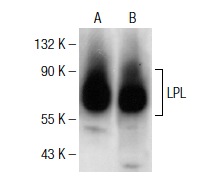
Western blot analysis of LPL expression in mouse heart (A) and rat heart (B) tissue extracts.Application
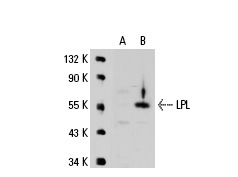
Western blot analysis of LPL expression in non-transfected: (A) and human LPL transfected: (B) 293 whole cell lysates.| Product Name | LPL Antibody (H-53) |
|---|---|
| Antibody Type | Primary Antibodies |
| Antigen Alias | epitope corresponding to amino acids 28-80 mapping near the N-terminus of LPL of human origin |
| Modification Notes | The Lipase gene family belongs to one of the most robust genetic superfamilies found in living organisms, which includes esterases and thioesterases. Lipase gene products are related by tertiary structure rather than primary amino acid sequence. Members of the AB hydrolase subfamily include hepatic lipase (HL), endothelial lipase (EL), lipoprotein lipase (LPL) and pancreatic lipase (PL). HL balances the composition and transport of lipoproteins in human plasma. Synthesized in endothelial cells, EL hydrolyzes high density lipoproteins. LPL, a homodimer attached to the membrane by a GPI-anchor, mediates the hydrolysis of triglycerides of very low density lipoproteins and circulating chylomicrons. Defects in LPL may cause chylomicronemia syndrome or a form of lipoprotein lipase deficiency characterized by hypertriglyceridemia. |
| Clonality | Polyclonal |
|---|---|
| Isotype | IgG |
| Host Species | Rabbit |
| Tested Applications | WBIPIFELISA |
| recommended for detection of Lipoprotein Lipase of mouse, rat and human origin by WB, IP, IF and ELISA also reactive with additional species, including canine: |
|
| Species Reactivity | HumanMouseRat |
| Concentration | 1mg/ml |
| Purification | Affinity purified |
| Alternative Names | epitope corresponding to amino acids 28-80 mapping near the N-terminus of LPL of human origin |
|---|---|
| Tissue Specificity | epitope corresponding to amino acids 28-80 mapping near the N-terminus of LPL of human origin |
| Entrez Gene | 4023 |
|---|
Application
Western blot analysis of LPL expression in mouse heart (A) and rat heart (B) tissue extracts.
Application
Western blot analysis of LPL expression in non-transfected: (A) and human LPL transfected: (B) 293 whole cell lysates.| Application Notes | recommended for detection of Lipoprotein Lipase of mouse, rat and human origin by WB, IP, IF and ELISA also reactive with additional species, including canine: |
|---|
| Form | Liquid |
|---|---|
| Storage Instructions | For short-term storage, store at 4° C. For long-term storage, aliquot and store at -20ºC or below. Avoid multiple freeze-thaw cycles. |
| Storage Buffer | phosphate buffered saline , pH 7.4, 150mM NaCl, 0.02% sodium azide and 50% glycerol. |


