Application
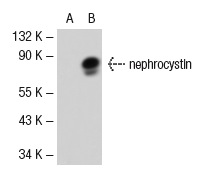
Western blot analysis of nephrocystin expression in non-transfected: (A) and human nephrocystin transfected: (B) 293T whole cell lysates.| Product Name | nephrocystin Antibody (H-300) |
|---|---|
| Antibody Type | Primary Antibodies |
| Antigen Alias | epitope corresponding to amino acids 433-732 mapping at the C-terminus of nephrocystin of human origin |
| Modification Notes | Clinical features of familial juvenile nephronophthisis include anemia, polyuria, polydipsia, isosthenuria, and death in uremia (1). Juvenile nephronophthisis type 1 is caused by mutations of NPHP1, the gene encoding for nephrocystin (1,2). Nephrocystin interacts with p130Cas (BCAR1), proline-rich tyrosine kinase-2 (PTK2B or Pyk2), and tensin in embryonic kidney and testis, indicating that these proteins participate in a common signaling pathway (1,2). Nephrocystin and p130Cas interact in mammalian cells and both proteins prominently localize at or near sites of cell-cell contact in polarized Madin-Darby canine kidney epithelial cells (3). Expression of nephrocystin results in phosphorylation of Pyk2 on Tyrosine 402 as well as activation of downstream mitogen-activated protein kinases, such as ERK1 and ERK2 (1,2). Nephrocystin contains a src-homology 3 (SH3) domain, which is highly conserved throughout evolution (4). The gene which encodes nephrocystin maps to human chromosome 2q13 (5). |
| Clonality | Polyclonal |
|---|---|
| Isotype | IgG |
| Host Species | Rabbit |
| Tested Applications | WBIPIFELISA |
| recommended for detection of nephrocystin isoforms 1-3 of mouse, rat and human origin by WB, IP, IF and ELISA also reactive with additional species, including equine, canine, bovine and porcine: |
|
| Species Reactivity | HumanMouseRat |
| Concentration | 1mg/ml |
| Purification | Affinity purified |
| Alternative Names | epitope corresponding to amino acids 433-732 mapping at the C-terminus of nephrocystin of human origin |
|---|---|
| Tissue Specificity | epitope corresponding to amino acids 433-732 mapping at the C-terminus of nephrocystin of human origin |
| Entrez Gene | 4867 |
|---|
Application
Western blot analysis of nephrocystin expression in non-transfected: (A) and human nephrocystin transfected: (B) 293T whole cell lysates.| Application Notes | recommended for detection of nephrocystin isoforms 1-3 of mouse, rat and human origin by WB, IP, IF and ELISA also reactive with additional species, including equine, canine, bovine and porcine: |
|---|
| Form | Liquid |
|---|---|
| Storage Instructions | For short-term storage, store at 4° C. For long-term storage, aliquot and store at -20ºC or below. Avoid multiple freeze-thaw cycles. |
| Storage Buffer | phosphate buffered saline , pH 7.4, 150mM NaCl, 0.02% sodium azide and 50% glycerol. |


