Application
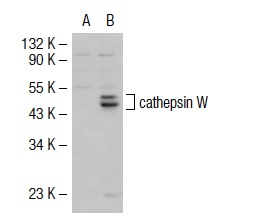
Western blot analysis of cathepsin W expression in non-transfected: (A) and human cathepsin W transfected: (B) 293T whole cell lysates.| Product Name | cathepsin W Antibody (H-165) |
|---|---|
| Antibody Type | Primary Antibodies |
| Antigen Alias | epitope corresponding to amino acids 128-292 mapping within an internal region of cathepsin W of human origin |
| Modification Notes | Cathepsin W (lymphopain) and cathepsin F comprise a novel subgroup of cathepsin proteases, and are phylogenetically distinct from other human cathepsins. The cathepsin W gene maps to chromosome 11q13.1 and contains ten exons with introns ranging from 81-119 bp. Cathepsin W protein is expressed specifically in CD8+ T lymphocytes. The expression of cathepsin W first occurs during the differentiation of thyrocytes to CD8+ T lymphocytes, just as the thymocytes cease expression of CD4+ receptors. In transfected Cos-7 and HeLa cells, cathepsin W localizes within the rough endoplasmic reticulum. Cathepsin W contains a unique 21 amino acid peptide insertion between the active site histidine and asparagine residues, in addition to a distictive 8-amino acid carboxy-terminal extension. An extended loop struc-ture in the second or beta-sheet domain and an additional disulfide bind are two of several signature features of cathepsin W. Other features of cathepsin W include an additional cysteine, an S2 pocket and an additional residue. Cathepsin W may exist as a dimer with each monomer forming a disulfide bond. |
| Clonality | Polyclonal |
|---|---|
| Isotype | IgG |
| Host Species | Rabbit |
| Tested Applications | WBIPIFELISA |
| recommended for detection of cathepsin W of mouse, rat and human origin by WB, IP, IF and ELISA: |
|
| Species Reactivity | HumanMouseRat |
| Concentration | 1mg/ml |
| Purification | Affinity purified |
| Alternative Names | epitope corresponding to amino acids 128-292 mapping within an internal region of cathepsin W of human origin |
|---|---|
| Tissue Specificity | epitope corresponding to amino acids 128-292 mapping within an internal region of cathepsin W of human origin |
| Entrez Gene | 1521 |
|---|
Application
Western blot analysis of cathepsin W expression in non-transfected: (A) and human cathepsin W transfected: (B) 293T whole cell lysates.| Application Notes | recommended for detection of cathepsin W of mouse, rat and human origin by WB, IP, IF and ELISA: |
|---|
| Form | Liquid |
|---|---|
| Storage Instructions | For short-term storage, store at 4° C. For long-term storage, aliquot and store at -20ºC or below. Avoid multiple freeze-thaw cycles. |
| Storage Buffer | phosphate buffered saline , pH 7.4, 150mM NaCl, 0.02% sodium azide and 50% glycerol. |


