Application
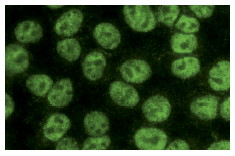
Immunofluorescence staining of methanol-fixed HeLa cells showing nuclear localization.| Product Name | TFII-I Antibody (H-58) |
|---|---|
| Antibody Type | Primary Antibodies |
| Antigen Alias | epitope corresponding to amino acids 941-998 of TFII-I of human origin |
| Modification Notes | Initiation of transcription of eukaryotic genes requires the association of large multimeric protein complexes that involve RNA polymerase II and a variety of basal transcription factors, including members of the TFII protein family (1,2). TFII proteins complex with Pol II and initiate transcription by binding to the core promoter elements, such as TATA box sequences, that are located upstream of the transcription start codon (3). A member of the TFII family, TFII-I is regulated by tyrosine phophorylation, and it is involved in the initiation of transcription of TATA-less promoters and in cell type specific transcription (4). TFII-I directly associates with several promoters elements, including TATA box, pyrimidine-rich initiator (Inr) and E-box elements (5). TFII-I is also implicated in activating transcription of the transcription factor c-fos, a downstream effector protein in the MAP kinase-signaling pathway (6). TFII-I binds to several initiation sites within the c-fos promoter, and it is phosphorylated in response to Map kinase activation, which then enhances TFII-I induced expression of c-fos (7,8). |
| Clonality | Polyclonal |
|---|---|
| Isotype | IgG |
| Host Species | Rabbit |
| Tested Applications | WBIPIFELISAGSChIP |
| recommended for detection of short and long isoforms of TFII-I of mouse, rat and human origin by WB, IP, IF and ELISA also reactive with additional species, including equine, canine, bovine and porcine: |
|
| Species Reactivity | HumanMouseRat |
| Concentration | 1mg/ml |
| Purification | Affinity purified |
| Alternative Names | epitope corresponding to amino acids 941-998 of TFII-I of human origin |
|---|---|
| Tissue Specificity | epitope corresponding to amino acids 941-998 of TFII-I of human origin |
| Entrez Gene | 2969 |
|---|
Application
Immunofluorescence staining of methanol-fixed HeLa cells showing nuclear localization.| Application Notes | recommended for detection of short and long isoforms of TFII-I of mouse, rat and human origin by WB, IP, IF and ELISA also reactive with additional species, including equine, canine, bovine and porcine: |
|---|
| Form | Liquid |
|---|---|
| Storage Instructions | For short-term storage, store at 4° C. For long-term storage, aliquot and store at -20ºC or below. Avoid multiple freeze-thaw cycles. |
| Storage Buffer | phosphate buffered saline , pH 7.4, 150mM NaCl, 0.02% sodium azide and 50% glycerol. |


