Application
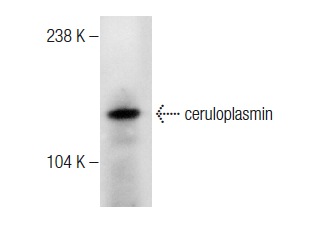
Western blot analysis of ceruloplasmin expression in human plasma whole cell lysate.Application
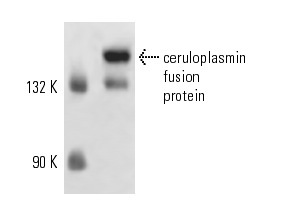
Western blot analysis of human recombinant ceruloplasmin fusion protein.| Product Name | ceruloplasmin Antibody (H-60) |
|---|---|
| Antibody Type | Primary Antibodies |
| Antigen Alias | epitope corresponding to amino acids 121-180 of ceruloplasmin of human origin |
| Modification Notes | Ceruloplasmin (CP) is a blue plasma glycoprotein that is synthesized in hepatocytes and transports copper throughout the body. Also known as ferroxidase, ceruloplasmin is the product of an intragenic triplication and is composed of three homologous domains. Two splice variants, CP-1 and CP-2, have differential expression in specific tissues. Ceruloplasmin mRNAs are expressed in human liver, macrophages and lymphocytes. Ceruloplasmin binds copper and has six or seven cupric ions per molecule. It is involved in peroxidation of Fe(II) transferrin to form Fe(III) transferrin. Ceruloplasmin is proteolytically degraded to a short form, which still possesses ferroxidase activity. However, only the intact long form is able to catalyze iron loading into ferritin, indicating that the structural integrity of ceruloplasmin is essential for the enzyme to effectively catalyze iron loading into ferritin. Ceruloplasmin also induces low density lipoprotein oxidation in vitro, an action that depends on the presence of a single, chelatable Cu atom. A glycosyl phosphatidylinositol (GPI)-anchored form of ceruloplasmin is expressed by Sertoli cells, which may be the dominant form in Sertoli cells. |
| Clonality | Polyclonal |
|---|---|
| Isotype | IgG |
| Host Species | Rabbit |
| Tested Applications | WBIPIFELISA |
| recommended for detection of ceruloplasmin of human and, to a lesser extent, mouse and rat origin by WB, IP, IF and ELISA: |
|
| Species Reactivity | HumanMouseRat |
| Concentration | 1mg/ml |
| Purification | Affinity purified |
| Alternative Names | epitope corresponding to amino acids 121-180 of ceruloplasmin of human origin |
|---|---|
| Tissue Specificity | epitope corresponding to amino acids 121-180 of ceruloplasmin of human origin |
| Entrez Gene | 1356 |
|---|
Application
Western blot analysis of ceruloplasmin expression in human plasma whole cell lysate.
Application
Western blot analysis of human recombinant ceruloplasmin fusion protein.| Application Notes | recommended for detection of ceruloplasmin of human and, to a lesser extent, mouse and rat origin by WB, IP, IF and ELISA: |
|---|
| Form | Liquid |
|---|---|
| Storage Instructions | For short-term storage, store at 4° C. For long-term storage, aliquot and store at -20ºC or below. Avoid multiple freeze-thaw cycles. |
| Storage Buffer | phosphate buffered saline , pH 7.4, 150mM NaCl, 0.02% sodium azide and 50% glycerol. |


