Application
Western blot analysis of PPARγ expression in U-937 whole cell lysate.Application
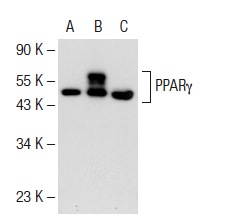
Western blot analysis of PPARγ expression in non-transfected 293T: (A), human PPARγ transfected 293T: (B) and THP-1 (C) whole cell lysates.Application
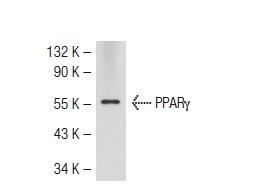
Western blot analysis of human recombinant PPARγ.Application
Western blot analysis of PPARγ expression in non-transfected: (A) and mouse PPARγ transfected: (B) 293T whole cell lysates.Application
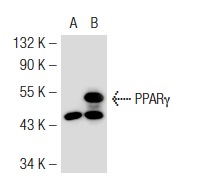
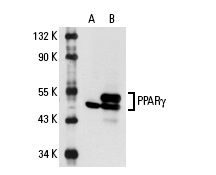
Western blot analysis of PPARγ expression in non-transfected: (A) and human PPARγ transfected: (B) 293T whole cell lysates.Application
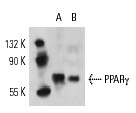
Western blot analysis of PPARγ expression in THP-1 (A) and 3T3-L1 (B) whole cell lysates.Application
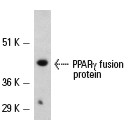
Western blot analysis of human recombinant PPARγ fusion protein.| Product Name | PPARγ Antibody (H-100) |
|---|---|
| Antibody Type | Primary Antibodies |
| Antigen Alias | epitope corresponding to amino acids 8-106 mapping at the N-terminus of PPARγ1 of human origin |
| Modification Notes | Peroxisome proliferator-activated receptors (PPARs) are members of the nuclear hormone receptor subfamily of transcription factors. PPARs form heterodimers with retinoid X receptors (RXRs). These heterodimers regulate transcription of genes involved in insulin action, adipocyte differentiation, lipid metabolism and inflammation. PPAR© is implicated in numerous diseases including obesity, diabetes, atherosclerosis and cancer. PPAR© activators include prostanoids, fatty acids, thiazolidinediones and N-(2-benzoylphenyl) tyrosine analogues. A key component in adipocyte differentiation and fat-specific gene expression, PPAR© may modulate macrophage functions such as proinflammatory activities, and stimulate oxidized low-density lipoprotein (x-LDL) uptake. A Pro12Ala polymorphism of the PPAR©2 gene has been reported to reduce transactivation activity in vitro. This substitution may affect the immune response to ox-LDL and be associated with type 2 diabetes. In addition, the Pro12Ala variant of the PPAR©2 gene maybe correlated with abdominal obesity in type 2 diabetes. |
| Clonality | Polyclonal |
|---|---|
| Isotype | IgG |
| Host Species | Rabbit |
| Tested Applications | WBIPIFELISAGSChIP |
| recommended for detection of PPARγ1 and PPARγ2 of mouse, rat and human origin by WB, IP, IF and ELISA also reactive with additional species, including equine, canine and porcine: |
|
| Species Reactivity | HumanMouseRat |
| Concentration | 1mg/ml |
| Purification | Affinity purified |
| Alternative Names | epitope corresponding to amino acids 8-106 mapping at the N-terminus of PPAR&gamma 1 of human origin |
|---|---|
| Tissue Specificity | epitope corresponding to amino acids 8-106 mapping at the N-terminus of PPARγ1 of human origin |
| Entrez Gene | 5468 |
|---|
Application
Western blot analysis of PPARγ expression in U-937 whole cell lysate.
Application
Western blot analysis of PPARγ expression in non-transfected 293T: (A), human PPARγ transfected 293T: (B) and THP-1 (C) whole cell lysates.
Application
Western blot analysis of human recombinant PPARγ.
Application
Western blot analysis of PPARγ expression in non-transfected: (A) and mouse PPARγ transfected: (B) 293T whole cell lysates.
Application
Western blot analysis of PPARγ expression in non-transfected: (A) and human PPARγ transfected: (B) 293T whole cell lysates.
Application
Western blot analysis of PPARγ expression in THP-1 (A) and 3T3-L1 (B) whole cell lysates.
Application
Western blot analysis of human recombinant PPARγ fusion protein.| Application Notes | recommended for detection of PPARγ1 and PPARγ2 of mouse, rat and human origin by WB, IP, IF and ELISA also reactive with additional species, including equine, canine and porcine: |
|---|
| Form | Liquid |
|---|---|
| Storage Instructions | For short-term storage, store at 4° C. For long-term storage, aliquot and store at -20ºC or below. Avoid multiple freeze-thaw cycles. |
| Storage Buffer | phosphate buffered saline , pH 7.4, 150mM NaCl, 0.02% sodium azide and 50% glycerol. |


