Application
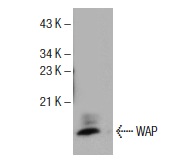
Western blot analysis of WAP expression in CSMLO whole cell lysate.Application
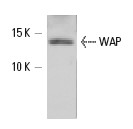
Western blot analysis of WAP expression in rat pituitary gland tissue extract.| Product Name | WAP Antibody (R-131) |
|---|---|
| Antibody Type | Primary Antibodies |
| Antigen Alias | epitope corresponding to amino acids 7-137 mapping at the C-terminus of WAP of rat origin |
| Modification Notes | Whey acidic protein (WAP), a hormonally-regulated acidic, cysteine-rich protein, is a major whey protein found in rodent milk (1) and may belong to a family of protease inhibitors (2). The WAP gene consists of four exons and three introns. The middle two exons encode the two cysteine-rich regions which form separate protein domains (1-4). WAP also contain a N-terminal signal peptide of 19 amino acids (3). The WAP gene is expressed in mammary epithelial cells, is induced several thousand-fold during pregnancy and is under the control of lactogenic hormones (5-6). Induction of WAP gene is caused by glucocorticoid, PRL, and insulin (6). Expression of WAP mRNA is highly dependent on stage of estrous, with detection restricted to midcycle (7). Low levels of WAP RNA are found in some nonmammary tissues such as tongue, pancreas, and pituitary gland, but not in others, for examle, heart and brain (8). WAP secretion in milk occurs throughout lactation and is restricted to number of species, including mouse, rat, rabbit, camel, and pig (8). Mouse mammary epithelial cells cultured on basement membrane-type matrix express high levels of WAP mRNA and secrete the protein into the lumen. This expression is dependent upon the formation of the alveoli-like spheres (9). |
| Clonality | Polyclonal |
|---|---|
| Isotype | IgG |
| Host Species | Rabbit |
| Tested Applications | WBIPIFELISA |
| recommended for detection of WAP of mouse and rat origin by WB, IP, IF and ELISA: |
|
| Species Reactivity | HumanMouseRat |
| Concentration | 1mg/ml |
| Purification | Affinity purified |
| Alternative Names | epitope corresponding to amino acids 7-137 mapping at the C-terminus of WAP of rat origin |
|---|---|
| Tissue Specificity | epitope corresponding to amino acids 7-137 mapping at the C-terminus of WAP of rat origin |
| Entrez Gene | 22373 |
|---|
Application
Western blot analysis of WAP expression in CSMLO whole cell lysate.
Application
Western blot analysis of WAP expression in rat pituitary gland tissue extract.| Application Notes | recommended for detection of WAP of mouse and rat origin by WB, IP, IF and ELISA: |
|---|
| Form | Liquid |
|---|---|
| Storage Instructions | For short-term storage, store at 4° C. For long-term storage, aliquot and store at -20ºC or below. Avoid multiple freeze-thaw cycles. |
| Storage Buffer | phosphate buffered saline , pH 7.4, 150mM NaCl, 0.02% sodium azide and 50% glycerol. |


