Application
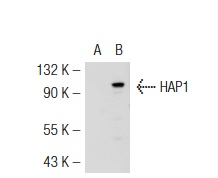
Western blot analysis of HAP1 expression in non-transfected: (A) and mouse HAP1 transfected: (B) 293T whole cell lysates.| Product Name | HAP1 Antibody (M-300) |
|---|---|
| Antibody Type | Primary Antibodies |
| Antigen Alias | epitope corresponding to amino acids 329-628 mapping at the C-terminus of HAP1B of mouse origin |
| Modification Notes | HAP1 (Huntingtin-associated protein 1) binds to Huntingtin. Huntingtin is a protein that contains a polyglutamine region and when the number of glutamine repeats exceeds 35, the gene encodes a version of Huntingtin that leads to Huntington’s disease (HD). The ability of HAP1 to bind to Huntingtin is enhanced by an expanded polyglutamine repeat region. HAP1 shows neuronal localization and moves with Huntingtin in nerve fibers. HAP1 is primarily expressed in brain tissue, with greater expression in the olfactory bulb and brain stem. HAP1 in rat has been shown to associate with a number of intracellular organelles. Mouse HAP1 is localized to membrane-bound organelles including large endosomes, tubulovesicular structures and budding vesicles in neurons. |
| Clonality | Polyclonal |
|---|---|
| Isotype | IgG |
| Host Species | Rabbit |
| Tested Applications | WBIPIFELISA |
| recommended for detection of HAP1A and HAP1B of mouse and rat origin by WB, IP, IF and ELISA: |
|
| Species Reactivity | HumanMouseRat |
| Concentration | 1mg/ml |
| Purification | Affinity purified |
| Alternative Names | epitope corresponding to amino acids 329-628 mapping at the C-terminus of HAP1B of mouse origin |
|---|---|
| Tissue Specificity | epitope corresponding to amino acids 329-628 mapping at the C-terminus of HAP1B of mouse origin |
| Entrez Gene | 15114 |
|---|
Application
Western blot analysis of HAP1 expression in non-transfected: (A) and mouse HAP1 transfected: (B) 293T whole cell lysates.| Application Notes | recommended for detection of HAP1A and HAP1B of mouse and rat origin by WB, IP, IF and ELISA: |
|---|
| Form | Liquid |
|---|---|
| Storage Instructions | For short-term storage, store at 4° C. For long-term storage, aliquot and store at -20ºC or below. Avoid multiple freeze-thaw cycles. |
| Storage Buffer | phosphate buffered saline , pH 7.4, 150mM NaCl, 0.02% sodium azide and 50% glycerol. |


