Application
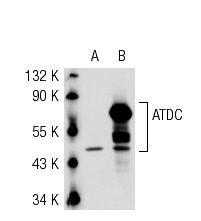
Western blot analysis of ATDC expression in non-transfected: (A) and human ATDC transfected: (B) 293T whole cell lysates.Application
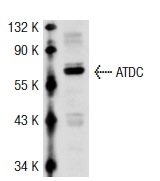
Western blot analysis of ATDC expression in mouse PBL tissue extract.| Product Name | ATDC Antibody (H-300) |
|---|---|
| Antibody Type | Primary Antibodies |
| Antigen Alias | epitope corresponding to amino acids 289-588 mapping at the C-terminus of ATDC of human origin |
| Modification Notes | Ataxia-telangiectasia (AT) is an autosomal recessive human genetic disease characterized by an elevated risk of cancer, immune defects, genetic instability and an increased sensitivity to radiation (1,2). For example, 10-15% of AT patients suffer an extremely high incidence of lymphoid malignancies incuding both T and B cell tumors by early adulthood (3). Interestingly, there is a total absence of myloid tumors in these patients (3). Although AT homozygotes are rare, the AT gene is likely to play a role in sporadic breast cancer and other common cancers. The human AT gene has been mapped to chromosome 11q22-q23. The AT group D complementing gene has been cloned (4). The protein, designated ATDC, has been shown to interact with the intermediate filament protein vimentin, a substrate for the PKC family of protein kinases, and with hPKCI-1, an inhibitor of the PKCs (5,6). Examination of the predicted ATDC amino acid sequence has revealed the presence of both zinc finger and leucine zipper motifs, suggesting that the protein may form homodimers and possibly associate with DNA (7). |
| Clonality | Polyclonal |
|---|---|
| Isotype | IgG |
| Host Species | Rabbit |
| Tested Applications | WBIPIFELISA |
| recommended for detection of ATDC α and β isoforms of mouse, rat and human origin by WB, IP, IF and ELISA also reactive with additional species, including equine, canine, bovine and porcine: |
|
| Species Reactivity | HumanMouseRat |
| Concentration | 1mg/ml |
| Purification | Affinity purified |
| Alternative Names | epitope corresponding to amino acids 289-588 mapping at the C-terminus of ATDC of human origin |
|---|---|
| Tissue Specificity | epitope corresponding to amino acids 289-588 mapping at the C-terminus of ATDC of human origin |
| Entrez Gene | 23650 |
|---|
Application
Western blot analysis of ATDC expression in non-transfected: (A) and human ATDC transfected: (B) 293T whole cell lysates.
Application
Western blot analysis of ATDC expression in mouse PBL tissue extract.| Application Notes | recommended for detection of ATDC α and β isoforms of mouse, rat and human origin by WB, IP, IF and ELISA also reactive with additional species, including equine, canine, bovine and porcine: |
|---|
| Form | Liquid |
|---|---|
| Storage Instructions | For short-term storage, store at 4° C. For long-term storage, aliquot and store at -20ºC or below. Avoid multiple freeze-thaw cycles. |
| Storage Buffer | phosphate buffered saline , pH 7.4, 150mM NaCl, 0.02% sodium azide and 50% glycerol. |


