Application
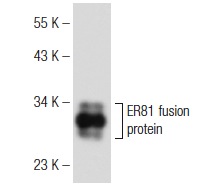
Western blot analysis of human recombinant ER81 fusion protein.Application
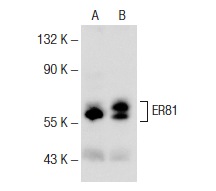
Western blot analysis of ER81 expression in HeLa (A) and LNCaP (B) whole cell lysates.| Product Name | ER81 Antibody (H-70) |
|---|---|
| Antibody Type | Primary Antibodies |
| Antigen Alias | epitope corresponding to amino acids 121-190 mapping within an internal region of ER81 of human origin |
| Modification Notes | Several members of the Ets gene family encode sequence-specific DNA binding proteins that recognize DNA sequences with a centrally located 5'-GGAA-3' element. All of the Ets proteins recognize the same central core sequence but each protein interacts with unique sequences that flank this core. PEA3 binds the motif 5'-AGGAAG-3', while ER81 (also designated ETV1) binds the motif 5'-CGGAA/T-3'. PEA3 is expressed at readily detectable levels in cells of epithelial and fibroblastic origin. Unlike other members of the Ets family, including Ets-1 and Ets-2, PEA3 is not expressed in hematopoietic cells. ER81 is highly expressed in brain, testis, lung and heart. ER81 is also moderately expressed in spleen, pancreas, colon and small intestine. During development, ER81, PEA3 and ERM display unique expression patterns which suggest these transcriptional factors play an important role in organogenesis. ERK-1 activates ER81 transcriptional activity, while MAPKAP kinase 2 inhibits ER81. |
| Clonality | Polyclonal |
|---|---|
| Isotype | IgG |
| Host Species | Rabbit |
| Tested Applications | WBIPIFELISAGSChIP |
| recommended for detection of ER81 of mouse, rat and human origin by WB, IP, IF and ELISA also reactive with additional species, including equine, canine, bovine, porcine and avian: |
|
| Species Reactivity | HumanMouseRat |
| Concentration | 1mg/ml |
| Purification | Affinity purified |
| Alternative Names | epitope corresponding to amino acids 121-190 mapping within an internal region of ER81 of human origin |
|---|---|
| Tissue Specificity | epitope corresponding to amino acids 121-190 mapping within an internal region of ER81 of human origin |
| Entrez Gene | 2115 |
|---|
Application
Western blot analysis of human recombinant ER81 fusion protein.
Application
Western blot analysis of ER81 expression in HeLa (A) and LNCaP (B) whole cell lysates.| Application Notes | recommended for detection of ER81 of mouse, rat and human origin by WB, IP, IF and ELISA also reactive with additional species, including equine, canine, bovine, porcine and avian: |
|---|
| Form | Liquid |
|---|---|
| Storage Instructions | For short-term storage, store at 4° C. For long-term storage, aliquot and store at -20ºC or below. Avoid multiple freeze-thaw cycles. |
| Storage Buffer | phosphate buffered saline , pH 7.4, 150mM NaCl, 0.02% sodium azide and 50% glycerol. |


