Application
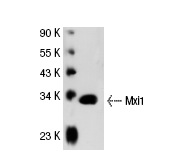
Western blot analysis of Mxi1 expression in U-937 whole cell lysate.Application
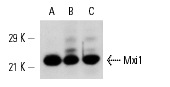
Western blot analysis of Mxi1 expression in U-937 (A), K-562 (B) and IMR-32 (C) whole cell lysates.| Product Name | Mxi1 Antibody (G-16) |
|---|---|
| Antibody Type | Primary Antibodies |
| Antigen Alias | epitope mapping near the C-terminus of Mxi1 of human origin |
| Modification Notes | It is now well established that Myc regulation of cell proliferation and differentiation involves a family of related transcription factors. One such factor, Max, is an obligate heterodimeric partner for Myc and can also form heterodimers with at least four related proteins designated Mad 1, Mxi1, Mad 3 and Mad 4. Like Mad 1 and Mxi1, association of Mad 3 and Mad 4 with Max results in transcriptional repression. Both Myc and the Mad proteins have short half-lives and their synthesis is tightly regulated, while Max expression is constitutive and relatively stable. Two related mammalian cDNAs have been identified and shown to encode Mad-binding proteins. Both possess sequence homology with the yeast transcription repressor Sin3 including four conserved paired amphipathic helix (PAH) domains. mSin3A and mSin3B specifically interact with the Mad proteins via their second paired amphipathic helix domain (PAH2). It has been suggested that Mad-Max heterodimers repress transcription by tethering mSin3 to DNA as corepressors. |
| Clonality | Polyclonal |
|---|---|
| Isotype | IgG |
| Host Species | Rabbit |
| Tested Applications | WBIPIFELISAGSChIP |
| recommended for detection of Mxi1 (Max interacting protein 1, also designated Mad 2) of h, r and, to a lesser extent, mouse origin by WB, IP, IF and ELISA also reactive with additional species, including canine, bovine, porcine and avian: |
|
| Species Reactivity | HumanMouseRat |
| Concentration | 1mg/ml |
| Purification | Affinity purified |
| Alternative Names | epitope mapping near the C-terminus of Mxi1 of human origin |
|---|---|
| Tissue Specificity | epitope mapping near the C-terminus of Mxi1 of human origin |
| Entrez Gene | 4601 |
|---|
Application
Western blot analysis of Mxi1 expression in U-937 whole cell lysate.
Application
Western blot analysis of Mxi1 expression in U-937 (A), K-562 (B) and IMR-32 (C) whole cell lysates.| Application Notes | recommended for detection of Mxi1 (Max interacting protein 1, also designated Mad 2) of h, r and, to a lesser extent, mouse origin by WB, IP, IF and ELISA also reactive with additional species, including canine, bovine, porcine and avian: |
|---|
| Form | Liquid |
|---|---|
| Storage Instructions | For short-term storage, store at 4° C. For long-term storage, aliquot and store at -20ºC or below. Avoid multiple freeze-thaw cycles. |
| Storage Buffer | phosphate buffered saline , pH 7.4, 150mM NaCl, 0.02% sodium azide and 50% glycerol. |


