Application
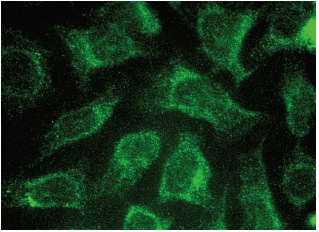
Immunofluorescence staining of methanol-fixed HeLa cells showing membrane localization.Application
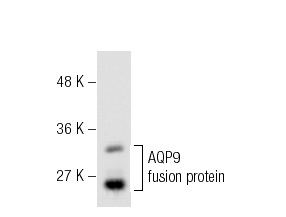
Western blot analysis of human recombinant AQP9 fusion protein.| Product Name | AQP9 Antibody (H-40) |
|---|---|
| Antibody Type | Primary Antibodies |
| Antigen Alias | epitope corresponding to amino acids 179-218 mapping within an internal region of AQP9 of human origin |
| Modification Notes | Human AQP9 (Aquaporin 9) is a 295 amino acid protein that allows passage of a wide variety of noncharged solutes and stimulates osmotic water permeability. Aquaporins (AQPs) are a large family of integral membrane water transport channel proteins that facilitate the transport of water through the cell membrane. This function is conserved in animals, plants and bacteria. Many isoforms of aquaporin have been identified in mammals, designated AQP0 through AQP10. Aquaporins are widely distributed and it is not uncommon for more than one type of AQP to be present in the same cell. Although most aquaporins are only permeable to water, AQP3, AQP7, AQP9 and one of the two AQP10 transcripts are also permeable to urea and glycerol. Aquaporins are involved in renal water absorption, generation of pulmonary secretions, lacrimation, and the secretion and reabsorption of cerebrospinal fluid and aqueous humor. |
| Clonality | Polyclonal |
|---|---|
| Isotype | IgG |
| Host Species | Rabbit |
| Tested Applications | WBIPIFELISA |
| recommended for detection of AQP9 of mouse, rat and human origin by WB, IP, IF and ELISA also reactive with additional species, including equine and canine: |
|
| Species Reactivity | HumanMouseRat |
| Concentration | 1mg/ml |
| Purification | Affinity purified |
| Alternative Names | epitope corresponding to amino acids 179-218 mapping within an internal region of AQP9 of human origin |
|---|---|
| Tissue Specificity | epitope corresponding to amino acids 179-218 mapping within an internal region of AQP9 of human origin |
| Entrez Gene | 366 |
|---|
Application
Immunofluorescence staining of methanol-fixed HeLa cells showing membrane localization.
Application
Western blot analysis of human recombinant AQP9 fusion protein.| Application Notes | recommended for detection of AQP9 of mouse, rat and human origin by WB, IP, IF and ELISA also reactive with additional species, including equine and canine: |
|---|
| Form | Liquid |
|---|---|
| Storage Instructions | For short-term storage, store at 4° C. For long-term storage, aliquot and store at -20ºC or below. Avoid multiple freeze-thaw cycles. |
| Storage Buffer | phosphate buffered saline , pH 7.4, 150mM NaCl, 0.02% sodium azide and 50% glycerol. |


